

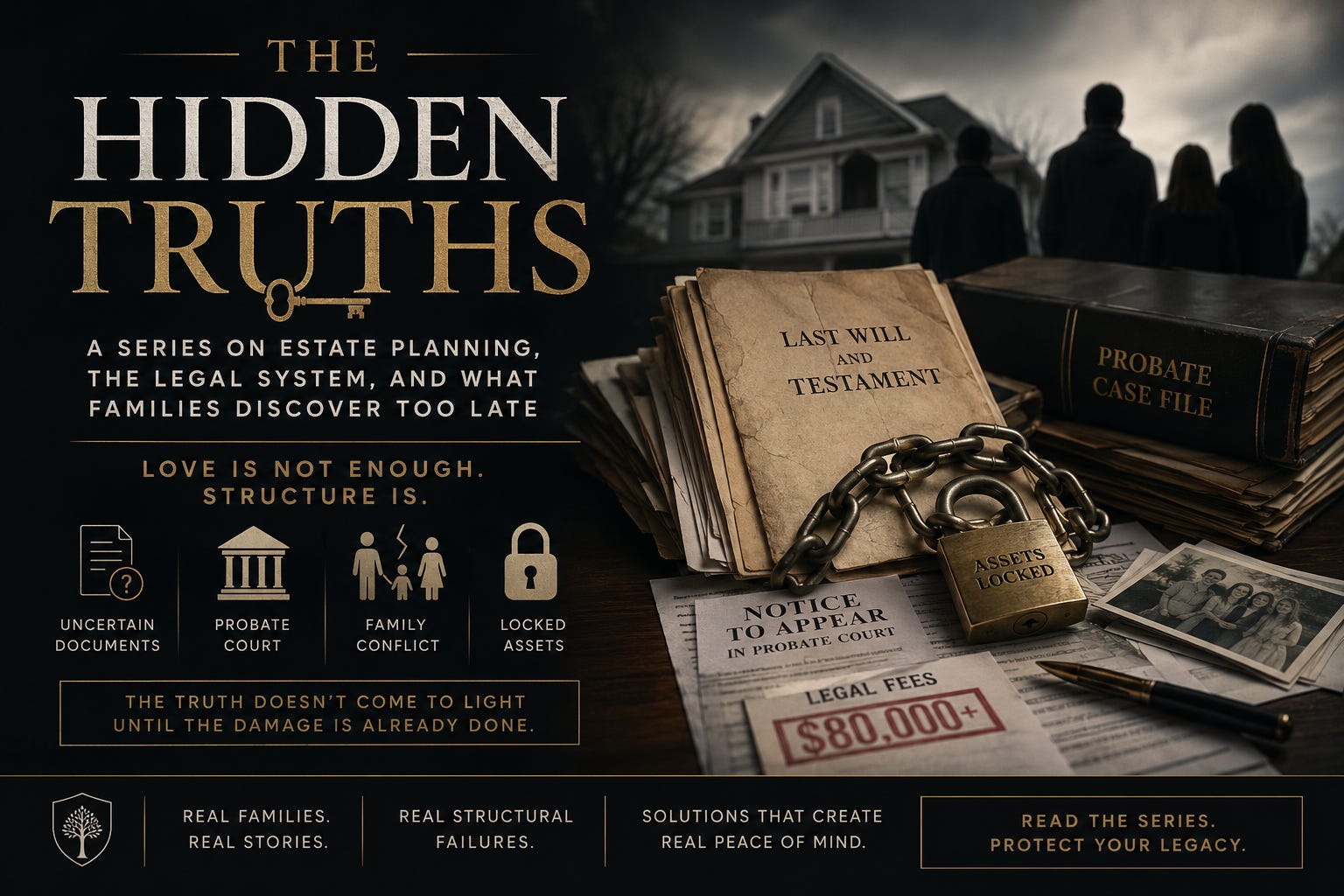
There is a family somewhere right now sitting in a lawyer’s office, learning that the will they signed fifteen years ago does not say what they thought it said. There is another family discovering that the savings account in their parent’s name only, the one they were counting on for funeral costs and the next month of bills, cannot be accessed without formal court authority. There is a third family in their kitchen on a Sunday morning, six months after a parent’s death, opening a notice from probate court that lists the legal fees consumed so far. None of these families were careless. None of them lacked love. All of them lacked structure they did not know was missing.
The Hidden Truths series names the specific gaps between what families believe their estate plans will do and what the legal system actually does after a death. Most of these gaps are invisible while everyone is alive. They appear at the moment when no one has time to address them: in the days and weeks after a loss, when the family is grieving, the court is moving at its own pace, and the documents that exist are quietly delivering outcomes that no one intended.
This series exists because most estate planning content focuses on what to buy, what to sign, and what to file. Almost none of it explains what happens when a document is missing, when a beneficiary designation contradicts a will, when a business has no succession plan, when a guardian was never named. The cost of those gaps is documented in court records, attorney fees, lost time, and broken relationships. It is rarely written about plainly.
Each post follows one family through one specific failure. The story is always specific. The mechanism is always structural. The argument is never that the family failed. The argument is always that the structure failed, and that the structure could have been built before it was needed.
The thesis underneath the series is straightforward: financial instability after a loss is almost never the result of insufficient love or insufficient wealth. It is almost always the result of insufficient structure. Structure is buildable. These posts show what it looks like when it is missing and what it looks like when it exists.
Read every post using the index below.
Post 01 — The Family War I Never Saw Coming
Sophie was sixteen when her parents died. What the absence of an estate plan cost her family across the next two years, $60,000 in legal fees and litigation, a house that deteriorated in probate, and a family that did not survive the process. Why the life insurance policy did not stop any of it.

Post 02 — Why Splitting Everything Equally Creates Inequality
The most intuitive instruction parents write into a will is also the one most likely to fracture the family. What happens when an illiquid asset must be divided evenly among siblings who do not agree on what to do with it, and why equal treatment is not the same as equitable treatment.

Post 03 — Who Will Raise Your Children
Most parents understand they should name a guardian. Almost none have done it. What a court actually does when no document exists, why the candidates the court considers may not be the ones the parents would have chosen, and why guardianship and financial guardianship are two separate decisions families rarely make together.

Post 04 — Why Your Debts Don’t Die With You
Most families assume debts end at death. Many do not. Which obligations follow an estate through probate, what they consume before any beneficiary receives anything, and how a co-signed loan or a business debt can become a surviving family member’s problem.

Post 05 — When Your Business Dies With You
A business is fundamentally different from any other asset a family owns. Four Arizona business owners show what happens when an entrepreneur dies without a succession plan: the immediate shutdown, the silent expiration, the slow bleed, and the fire sale. The estate planning crisis every entrepreneur ignores until it cannot be ignored.

Post 06 — The Probate Nightmare That Could Have Been Avoided
What the absence of one document cost one Arizona family: 847 days, $80,000 in legal fees, and roughly forty percent of the estate’s value. How a single active lawsuit and a single missing line of structure produced damage that legal resolution could not undo.

The series continues beyond these six anchor posts with extended coverage of specific scenarios: the special needs trust gap, the blended family conflict, the digital asset problem, the Arizona transfer-on-death deed, the beneficiary designation override, and dozens more. Each new post is added to this index as it publishes.
The Estate Planning Blueprint Masterclass is a free one-hour class for families who want to build an estate plan that holds up. It walks through the three things every plan needs to keep probate out, protect children from avoidable conflict, and pass wealth to the next generation cleanly. Readers who recognized the patterns in this post and want to start building the structure that prevents them can register here:
Register for the Masterclass

Readers who would prefer to discuss a specific situation directly can book a free consultation here: