


Before we get into this: I’m hosting a free masterclass on estate planning for Arizona families, including how to document your guardianship wishes in a way the court will honor. You can reserve your seat here: https://lastinglegacypro.com/webinar

At 3:17 in the morning, Jessica’s phone rang.
Not a forgotten homework call. Not a wrong number.
This was the kind of call parents don’t prepare for because preparing for it feels like inviting it in.
Her sister Amy and brother-in-law David had been in a car accident. They didn’t survive.
Jessica arrived at the hospital heartbroken and overwhelmed. What she didn’t know yet was that the paperwork nightmare she was about to walk into would outlast the grief by eight months.
Amy and David had two children: Emma, eight years old, and Tyler, five. They were devoted parents. They had talked more than once about who would raise the kids if something happened to them.
They just never put the answer in writing.
Three different relatives filed for custody. Emma and Tyler spent eight months moving between temporary homes, schools, and caregivers while the court sorted out what their parents had never formally decided.
The children lost their parents. Then they lost their stability. Then, in the ways that contested custody fights tend to operate, they lost pieces of their extended family too.
All of it traced back to one missing document.
What Most Parents Don’t Know About Guardianship
The common assumption is that if something happens, the family will figure it out. Someone will step up. Everyone knows who the kids should go to.
Courts do not operate on assumptions.
When parents die without legally naming guardians, the court does not simply hand children to the nearest willing relative. It opens a legal process that follows its own timeline, regardless of what the family believes or what the parents would have wanted.
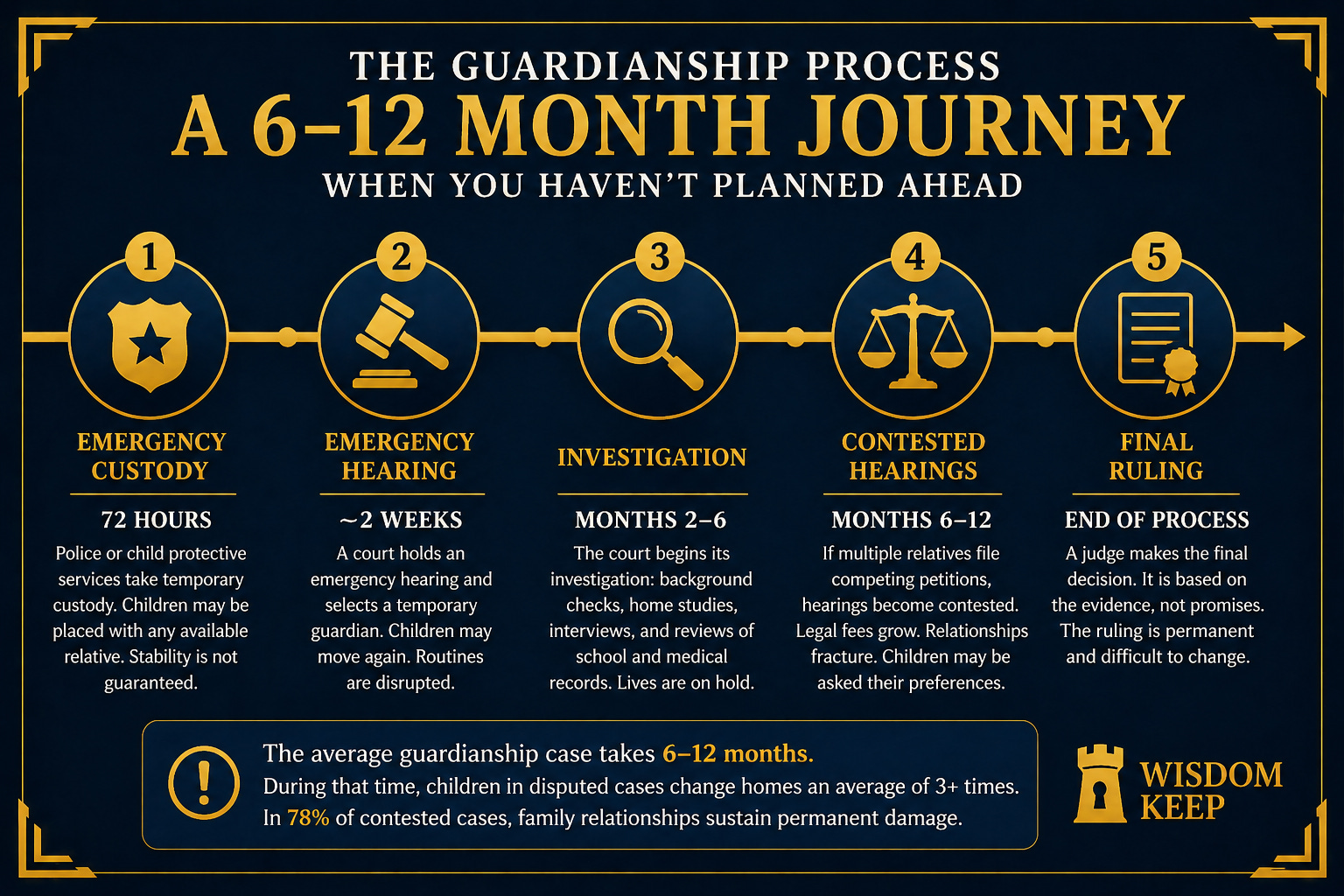
Roughly 69% of parents have no legal guardianship documents in place. The average court process for establishing guardianship takes six to twelve months. During that time, children in disputed cases change homes an average of three or more times. In 78% of contested guardianship cases, family relationships sustain permanent damage.
These are not outcomes that happen to negligent families. They happen to loving, involved parents who assumed the informal understanding would hold.
It does not hold. Not in court.
What the Process Actually Looks Like
Most people picture a simple handoff: the right relative steps forward and takes the children home. The actual sequence is considerably different.
In the first 72 hours, police or child protective services take temporary custody. Children may be placed with any available relative, not necessarily the person closest to them. Stability is not guaranteed.
Within the first two weeks, a court holds an emergency hearing and selects a temporary guardian. Children may move again. Their belongings, routines, pets, and school schedules get disrupted.
From months two through six, the court begins its investigation. Background checks, home studies, interviews with the children, and reviews of school and medical records. The children’s lives are on hold.
From months six through twelve, if multiple relatives have filed competing petitions, the hearings become contested. Legal fees accumulate. Relationships fracture. Children old enough to understand what is happening are sometimes asked directly about their preferences, which places them in an impossible position.
At the end of that process, a judge who never knew the parents, never met the children, and has no knowledge of the family’s values or relationships makes the permanent decision.
That is what the absence of a guardianship document produces.
Three Situations That Illustrate the Problem
The scenarios below are composites drawn from patterns I see in this work. The details change. The outcomes don’t.
The family war. A couple passed away leaving three children ages six, nine, and twelve. Four relatives filed separate petitions. The case ran fourteen months. The children moved five times, cycled through four different attorneys representing various family members, and by the end had lost contact with half their extended family. Their parents had talked about guardianship. They had never written it down.
The “everyone knows” situation. A woman named Sarah assumed her sister would raise her daughter if something happened. She never formalized it. When Sarah died unexpectedly, her sister was in the middle of a divorce. Sarah’s ex-husband, not biologically related to the child, filed for custody and was granted temporary placement for six months. The child changed schools twice. The court eventually reversed the placement, but the six months had already happened.
Assumptions are not legal instructions.
The geography problem. A ten-year-old boy had potential guardians in Florida, California, and Arizona. The people emotionally closest to him lived in Arizona. The family members with the strongest legal claim lived in California. The court sent him to California. Away from the community he knew. Away from the people he trusted.
A single document naming his guardians would have kept him in Arizona.
If this kind of analysis is useful to you, the best way to make sure you see future posts is to subscribe. It’s free.
How Parents Choose the Wrong Guardians
When parents do create guardianship documents, the most common error is choosing on the wrong criteria.
Blood relation is not a qualification. Income level is not a qualification. Living in a good school district is not a qualification.
The questions that actually matter are different ones. Do the potential guardians share the family’s values around faith, education, and discipline? Are they genuinely close to the children, or are they more familiar to the parents than to the kids? Are they stable enough, physically and emotionally, to take on the responsibility? Have they been asked directly and agreed? Would they actively maintain the children’s relationships with other family members, or would they tend to pull inward?
A guardian who checks every demographic box but answers those questions poorly is a worse choice than a close family friend who answers them well. Courts look at legal standing first. Parents who have documented their wishes give the court a clearer path to honoring what the family actually needs.
The Conversations That Have to Happen Before the Documents
Naming a guardian in a will is not the same as having the conversation with that person first.
The families I work with who have the smoothest outcomes are the ones who talked openly with their chosen guardians before anything was formalized. Not a one-time mention, but a real conversation: Are you willing to do this? How would you handle schooling and faith and discipline? Would you keep the kids connected to both sides of the family? What support would you need?
And underneath all of that: Do my children already feel safe with you? Not just comfortable. Safe.
The answer to that question tends to clarify everything else.
The Backup Structure Most Families Skip
Primary guardians are not enough on their own.
Life changes. The person who was the right choice five years ago may have moved, experienced a health crisis, or had their own family circumstances shift. A complete guardianship plan names primary guardians, secondary guardians, temporary or standby guardians for immediate placement, geographic alternatives if the primary choice requires relocation, and provisions for different age stages if the children are young enough that their needs will change significantly over time.
A plan built on a single name and no backups is one change away from unraveling.
The Legal Documents That Actually Protect Children
The paperwork side of guardianship is not complicated, but it does need to be complete.
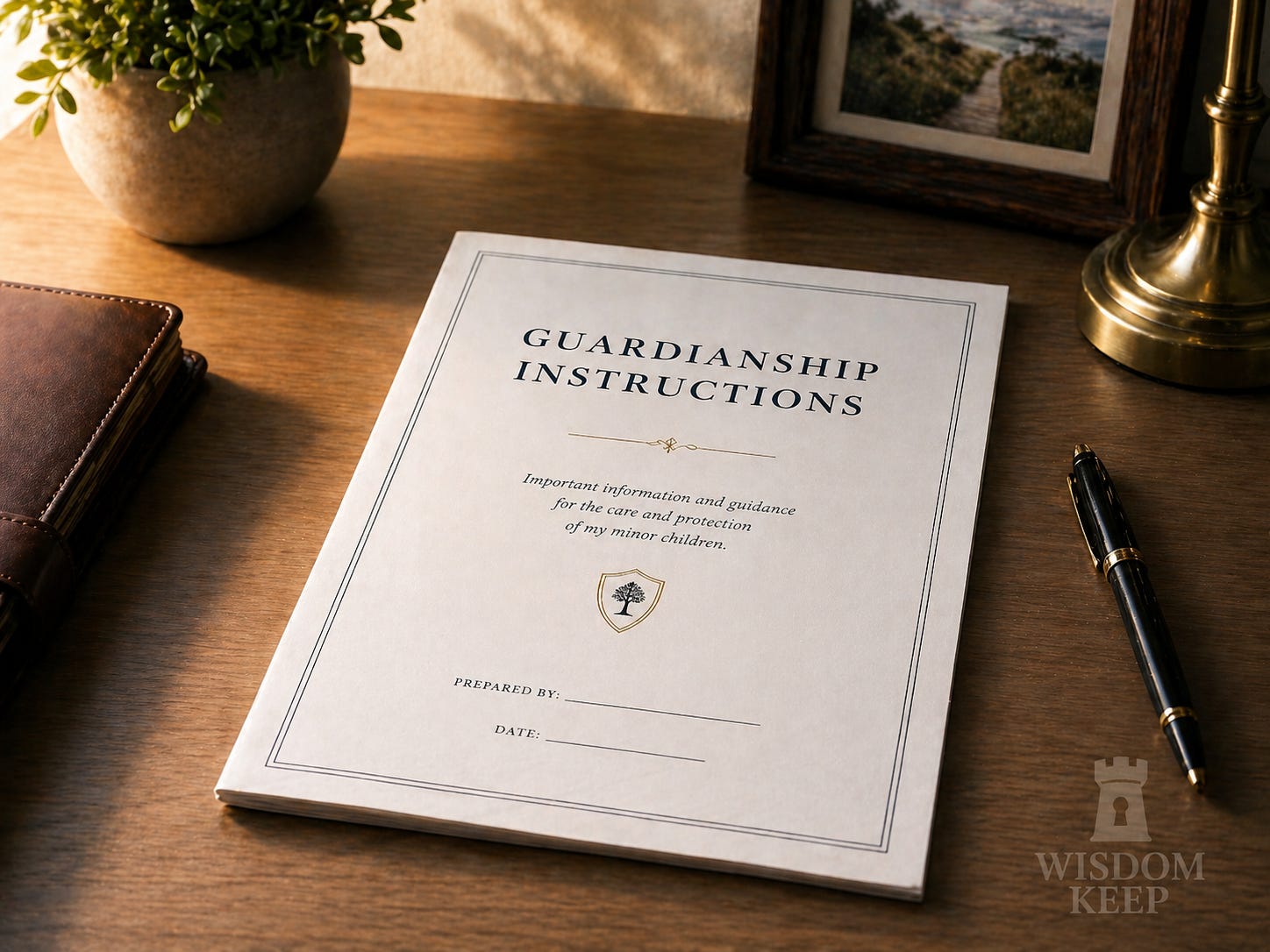
A will that names guardians is the foundation. Backup guardians should be named in the same document. Standby guardianship paperwork allows for immediate temporary placement without a court hearing, which matters enormously in those first 72 hours. A guardian instructions letter gives the chosen guardians specific guidance on values, routines, education, faith, and family relationships. A children’s trust ensures that any assets left to the children are managed appropriately until they are old enough to handle them.
Each of these pieces does a specific job. Missing any one of them creates a gap the court will fill on its own terms.
Arizona Families Have a Structural Advantage
Arizona law is relatively clear on guardian designation and gives courts a defined process for honoring parental wishes when those wishes are properly documented. When the documents are in place, the court has a path to follow. When they are not, the court builds its own.
The distinction matters most in those first 72 hours, when a standby guardianship document can prevent temporary placement with an unfamiliar relative and keep children in a stable environment while the formal process begins.
Planning ahead does not guarantee a smooth outcome, but it shifts the odds significantly.
The Question That Does Not Get Easier By Waiting
If both parents were gone tonight, who would raise the children? Where would they go? How quickly could they get there? Would their school, their friends, their routines, and their sense of home stay intact, or would all of it come apart while the legal process ran its course?
For families without documents in place, the honest answer to most of those questions is: it depends on who files first.
That is a solvable problem. It requires one conversation, followed by one set of documents, followed by a review every few years as circumstances change.
The families I have worked with in Arizona who complete this process consistently say the same thing afterward: they did not realize how much it had been sitting in the back of their minds until it was finished.
The court does not know your children. It does not know who they feel safe with, who they trust, or what their lives have been built around.
The only way that information gets into the room is if you put it there first.
Reserve Your Seat: Free Estate Planning Masterclass
I cover guardianship planning, wills, trusts, and the full framework for protecting an Arizona family in a free live masterclass. If you have been putting this off, this is the clearest starting point.
Reserve your seat: https://lastinglegacypro.com/webinar
If you would rather talk through your specific situation first, a free consultation is available here: https://lastinglegacypro.com/consultation



Nathaniel Vale / The Legacy Blueprint