

The Hidden Truths series Post 01
The Hidden Truths examines the gap between what families believe their estate plan will do and what the legal system actually does after a death. Each post follows one family through one specific failure that planning could have prevented.
Sophie was sixteen when her parents died.
She did not have time to process the loss before the questions started. Who would she live with? Who had legal authority to decide? Her older siblings were adults, but barely: one was in college, one was nineteen and not yet financially independent, and the others were scattered. There was no document that named anyone as responsible for her. So the court stepped in.
While adults argued about the house, the gun collection, the jewelry, and the bank accounts, Sophie moved between temporary placements. She missed parts of her senior year. She lost scholarship opportunities she will never recover. The family that had once been close stopped speaking.

Her parents, Mike and Lisa, had done a lot of things right. They owned a $400,000 home. They carried life insurance through work. They were the kind of parents who meant to get organized and fully intended to do it soon.
They just never did.
I work with families in situations like this more often than most people would guess. The specifics vary, but the structure is almost always the same: two caring parents, reasonable assets, a life insurance policy, and the assumption that having the policy means the family is protected. It is an understandable assumption. It is also wrong in ways that tend to surface at the worst possible moment.
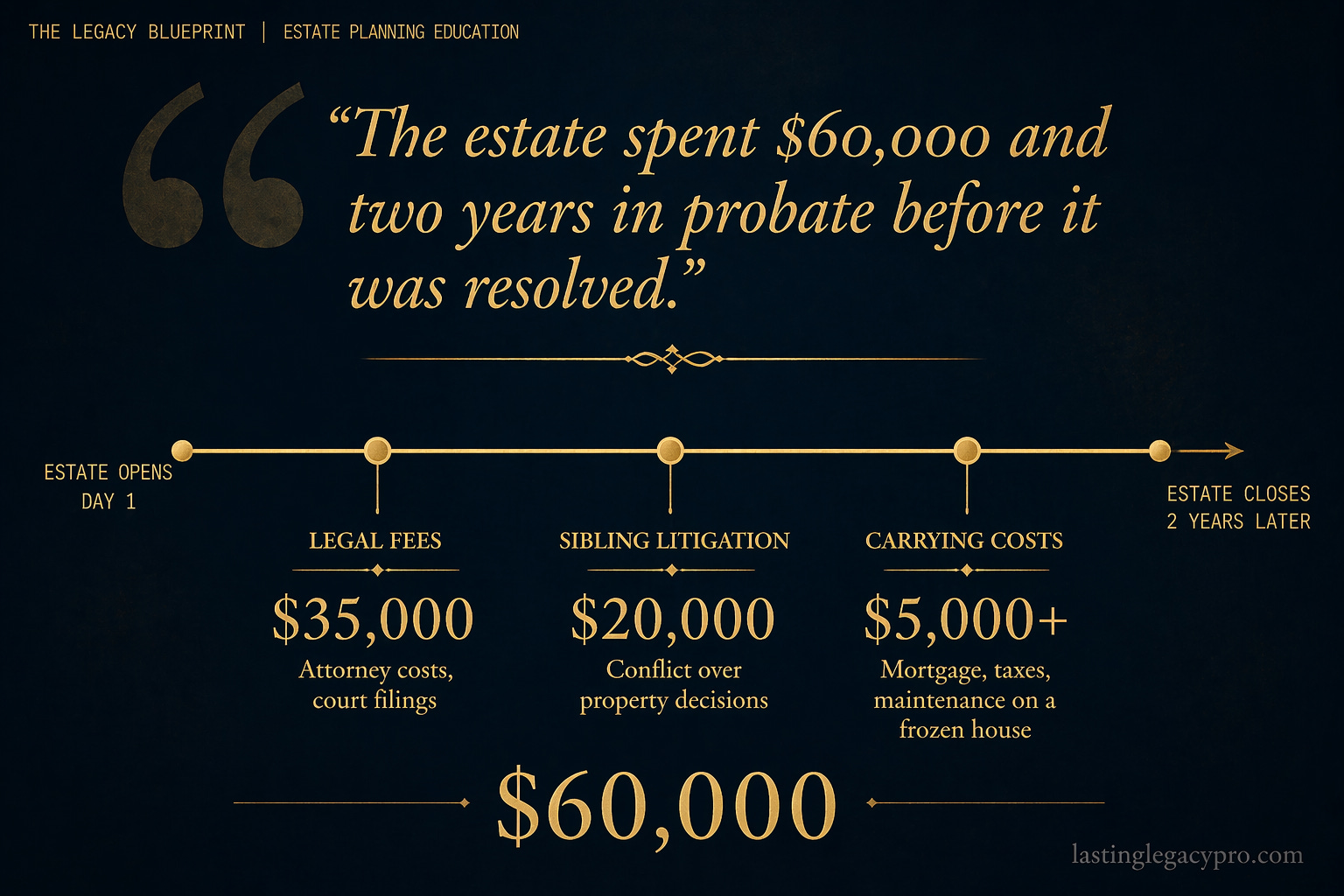
What happened to Mike and Lisa’s children is worth understanding in concrete terms. The estate spent $60,000 and two years in probate before it was resolved. The breakdown: $35,000 in legal fees, $20,000 in litigation driven by sibling disagreement, and more than $5,000 in mortgage payments, taxes, and maintenance costs on a house that sat frozen while the court process moved at its own pace. The house deteriorated during that period. The family fractured permanently.
Life insurance paid a benefit. That benefit did nothing to stop any of this.
The confusion about what life insurance does is worth addressing directly. A policy provides a financial payment to a named beneficiary. That is the complete scope of what it does. It does not determine who gets the house. It does not resolve disputes over personal property. It does not establish who has legal authority to act. It does not keep a family out of probate court. It does not name a guardian for a minor child.
Estate planning does those things. The two are not substitutes for each other. They address different problems.
When there is no plan, the probate process fills the gap. Assets freeze until the court sorts through them. No one has legal authority to sell the house, pay the mortgage, or distribute the personal property without court approval. Every decision slows to the pace of a legal proceeding. The expenses accumulate in the meantime, drawing down the estate before anyone receives anything.
The guardian situation is what I find families least prepared for, even when they have thought about estate planning in general terms. Most parents understand, in the abstract, that they should name a guardian. Very few have actually done it. The gap between knowing and doing is where Sophie’s story lives.
Without a named guardian, a court decides. The court does not know the family’s values, relationships, or preferences. It applies a legal standard to a human situation. In Sophie’s case, the candidates the court considered included people she barely knew. The adults with the closest relationships to her had no legal standing that a document could have established in fifteen minutes.
The document that would have resolved this entirely costs far less than one month of the probate process it was designed to prevent.
The other pattern I see regularly is the belief that splitting assets equally among children prevents conflict. The logic is intuitive: equal treatment means no one has a reason to argue. In practice, equal division of an illiquid asset, a house for instance, produces a situation where one sibling wants to sell, another wants to keep it, and a third cannot afford their share of the carrying costs. The asset cannot be divided without being sold, but the family cannot agree to sell. The house sits while the bills accumulate and the relationships deteriorate.
Clear instructions about how specific assets should be handled, who has authority to act, and in what sequence decisions should be made do not reduce what a family inherits. They reduce what the legal system takes before the family gets to it.
Mike and Lisa left behind children who loved them. The failure was structural, not personal. Two capable, caring parents operated under a set of assumptions about what their existing coverage meant, and those assumptions had never been tested against how the system actually works.
The system does not care about intentions. It responds to documents.
Sophie graduated, eventually. She rebuilt. But the family she grew up in did not survive the two years that followed her parents’ deaths. The loss of her parents was not something a document could have prevented. The loss of her family was.
I put together a free webinar specifically for families who want to understand what a complete estate plan actually does. The Estate Planning Blueprint Masterclass is a free one-hour class for families who want to build an estate plan that holds up. It walks through the three things every plan needs to keep probate out, protect children from avoidable conflict, and pass wealth to the next generation cleanly. Readers who recognized the patterns in this post and want to start building the structure that prevents them can register here:
Register for the Masterclass

Readers who would prefer to discuss a specific situation directly can book a free consultation here:
https://lastinglegacypro.com/estate-planning
Nathaniel Vale / The Legacy Blueprint Estate Planning for Families Who Want to Get It Right