


There is a specific moment most people can identify if they think about it. A child is struggling with something. The parent knows exactly how to solve it. The parent watches, waits, and does not intervene. Not because they are distracted. Not because they do not care. Because somewhere in the operating system running beneath the decision is a belief: the struggle is the point. If I solve it for them, I take something from them. If I let them fail, I give them something. The parent feels, however quietly, that the restraint is an act of love.

That moment is the grind gospel in its most intimate form. It is not a policy about trust funds or college tuition. It is a reflex. A conviction so embedded that it does not announce itself as a belief. It arrives as instinct.
The question worth asking is where that instinct came from. Not whether it exists. It clearly does. The question is what it was built on, and whether the foundation holds up when examined.
This series is not aimed at the parent who is consciously withholding to keep a child dependent. That is a different and documented pattern. This series is aimed at the neutral parent. The parent who genuinely believes that not intervening is the right call. The parent who absorbed the grind gospel without ever examining it and is now passing it forward as a form of care.
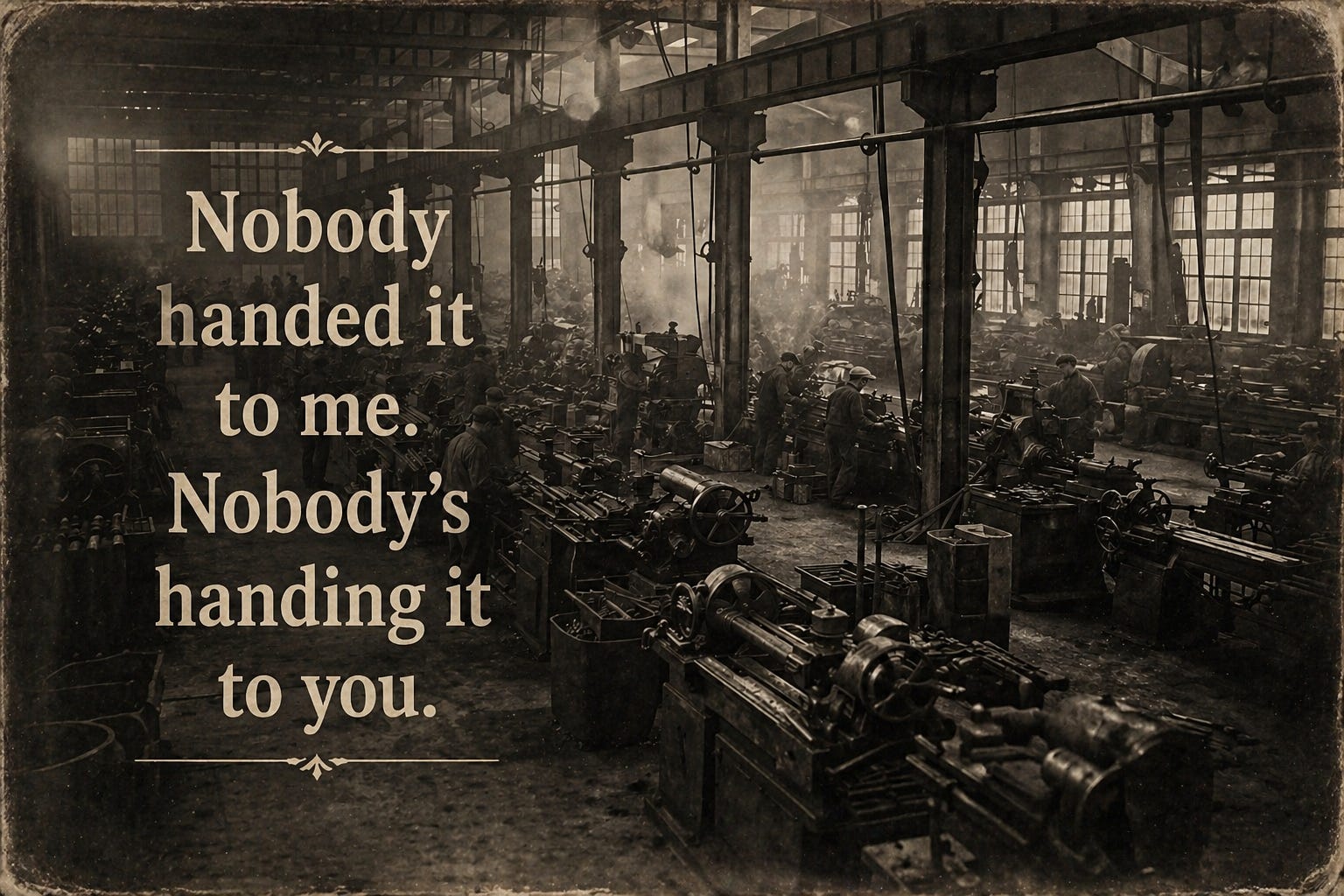
The equation between suffering and character has a history. It did not arrive as a conclusion from a study of what produces capable adults. It arrived from a much older place: from economies where most people had nothing, and where enduring difficulty was not optional.
For most of recorded history, the majority of families operated at or near subsistence. Hardship was not a pedagogical choice. It was the condition of life. When observers of that era noticed that people who had survived genuine deprivation tended to be resilient, the observation was accurate. What happened next was the error. The description of a condition was converted into a prescription for producing an outcome. Because people who had survived hardship were often tough, it was concluded that hardship produced toughness. The mechanism was assumed, not verified.
This is a category error. It confuses correlation with causation, and survival with instruction. It has a name: the Survivorship Error.
The men who endured the factories, the poverty, and the deprivation of the early industrial era and came through it resilient are the ones who had children. The ones who were broken by identical conditions, who never recovered, who died young or lived diminished lives, are not in the sample. They are not at the table telling the story. They never made it far enough to transmit a belief about what their hardship produced. What gets passed forward is the account of the survivors. The belief gets constructed on a sample that excludes all the counter-evidence by definition. Counting only the survivors and concluding that hardship produces resilience is the same logical error as counting only the businesses that survived a recession and concluding recessions are good for business. The sample was never complete. The conclusion was never earned.
A quote has circulated widely for roughly a decade that captures this error in its most distilled form: “Hard times create strong men. Strong men create good times. Good times create weak men. And weak men create hard times.” The line originates from a 2016 post-apocalyptic novel, not from history or research, yet it has spread across social media, parenting conversations, and cultural commentary as though it were established wisdom (Hopf, 2016). Whether a parent has encountered that quote directly or absorbed a version of its logic through culture, religion, or family tradition, the belief it encodes is the same: hardship is the mechanism. Produce the hardship and the strength follows. The parent operating on this belief is not trying to harm a child. The goal, a capable and resilient adult, is entirely legitimate. The question this series examines is whether the assumed mechanism actually produces that outcome.
The evidence introduces a complication the belief does not account for. Two children raised under identical conditions of adversity do not produce identical outcomes. One becomes a doctor. One becomes an alcoholic. One ends up in prison. The same starting conditions. Three entirely different lives. If hardship were the operative mechanism, the mechanism would produce consistent results. It does not. Which means something else is the variable. This series will examine what that variable actually is. The answer is not found in the presence or absence of difficulty. It is found in what surrounds the difficulty: the relational context, the floor of support, and whether the conditions exist to make meaning out of what was endured. Later posts in this series examine this distinction directly. For now it is enough to note that the inconsistency of outcomes under identical conditions is itself the evidence that the assumed mechanism was never the mechanism at all.
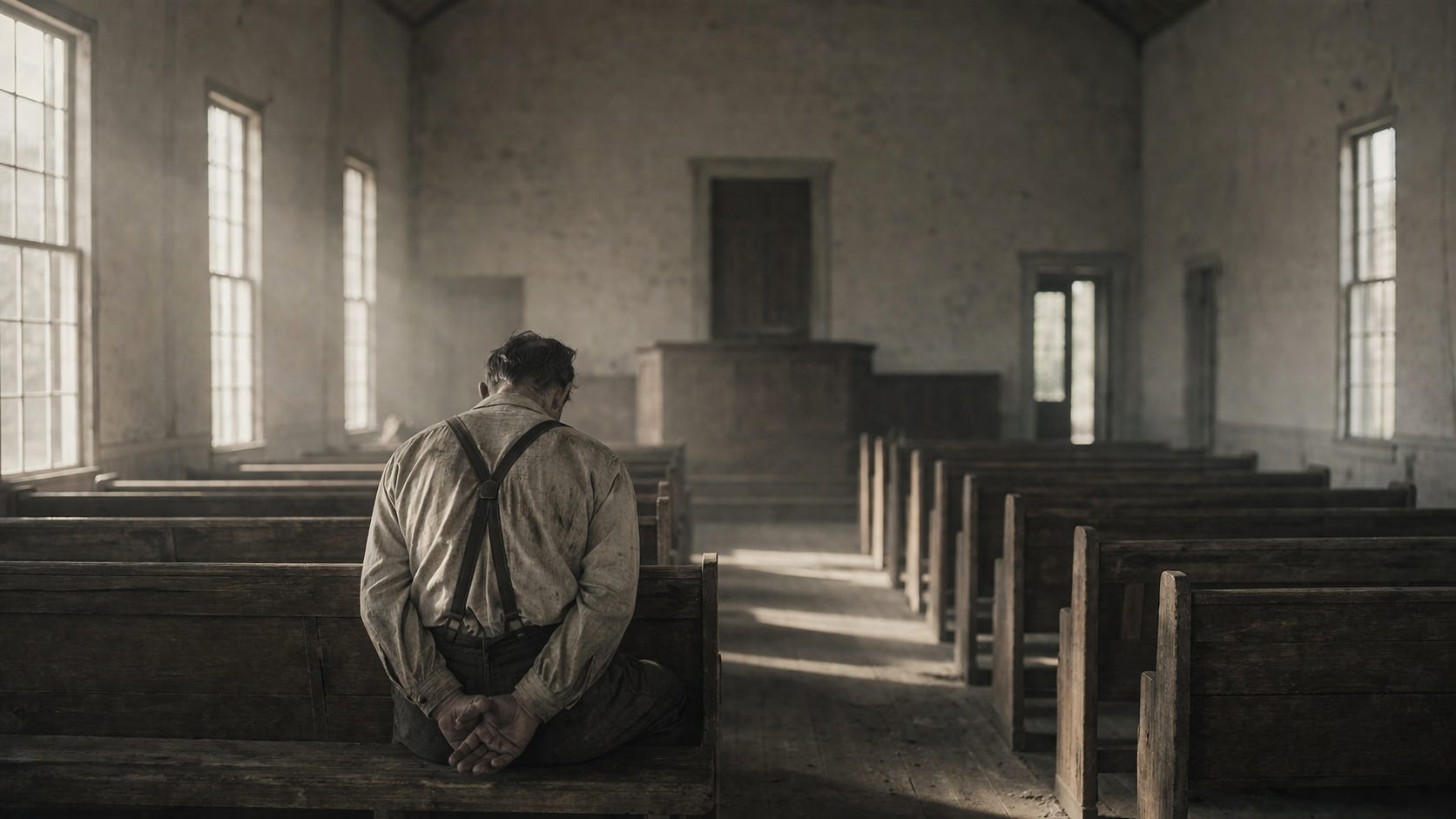
The equation picked up institutional weight through religious frameworks, particularly those in the Protestant and Calvinist traditions, that assigned moral value to labor, frugality, and the disciplined endurance of difficulty. As sociologist Max Weber documented in his foundational analysis of the relationship between Protestant theology and economic behavior, the Calvinist emphasis on a calling and the moral weight assigned to disciplined labor gave theological legitimacy to what had previously been simply a survival condition (Weber, 1904-1905). Ease became suspect. Comfort became a sign of softness or worse. The person who worked hard, asked for little, and accepted hardship without complaint was not just surviving. They were demonstrating virtue. The suffering was not incidental to the virtue. In this framing, the suffering was the virtue.
This gave the grind gospel something it did not previously have: theological legitimacy. It was no longer just a description of how poor people lived. It became a description of how good people lived.
The industrial economy that followed needed something from its workforce that this framework conveniently provided. Factory conditions in the nineteenth and early twentieth centuries were genuinely difficult. As historian David Montgomery documents in the U.S. Department of Labor’s institutional history of American labor, the cultural hero of late nineteenth century industrial society was the self-made man, and spokesmen of the era promoted a drive for achievement and acquisitive individualism that aligned worker identity with the acceptance of difficult conditions (Montgomery, n.d.). Long hours, dangerous environments, low wages, and limited recourse required a workforce that would accept those conditions without sustained rebellion. A cultural narrative that framed hard work and the endurance of difficulty as inherently noble, as signs of character and moral worth, served that economic structure without anyone having designed it to. The workers who internalized the grind gospel were easier to manage and cheaper to retain than workers who had not.
This is not a conspiracy. It is how cultural narratives and economic incentives interact. The people who benefited from the belief being widespread did not manufacture it. They simply did not correct it.
The more interesting question is what happened when the conditions that produced the belief began to change.
For a growing portion of families across the twentieth century, the economic necessity that had originally justified the grind gospel loosened. Not for everyone. Not evenly. But for many of the families now passing the belief to their children, genuine deprivation was no longer the condition of life. They had more. In some cases, significantly more. The thing the belief was originally describing, the necessity of enduring hardship because the alternative did not exist, was no longer the reality.
The belief did not update.
This is the second structural problem with the grind gospel as it operates today. Call it the Frozen Mechanism. The belief was accurate as a description of conditions that existed. It was never verified as a prescription for producing outcomes. And when the conditions changed, the belief did not change with them. It froze at the moment of origin and got transmitted forward as received wisdom into a world it was no longer describing.
It persisted not because the evidence continued to support it but because it had been inherited as identity. The parent who grew up in genuine scarcity and who survived that scarcity carried the belief not as a policy they had evaluated but as part of how they understood themselves. Their toughness, their discipline, their capability: these things felt connected to what they had been through. Giving a child an easier start felt like it was disconnecting the child from the source of those qualities. The fear was not really that the child would fail. The fear was that the child would succeed without earning it the right way, and that success without that foundation would be somehow hollow.
That fear is understandable. It is also untested. The parent who holds it has not verified that their toughness came from the hardship rather than from other variables. They have assumed the mechanism. Most people do. The assumption has never been asked to prove itself.
What the research does point toward, without prescribing a formula, is a different set of variables. The most precise evidence comes from a study that removed the relational variable entirely while keeping every material variable intact. In the 1940s, psychoanalyst René Spitz compared two groups of institutionalized infants. Both groups received adequate medical care, nutrition, and hygiene. One group also had consistent emotional contact with caregivers. The other did not. The infants with adequate physical care but without emotional connection showed severe developmental delays, stunted growth, and in documented cases, death. Spitz named the condition hospitalism and concluded that the child does not need only material care but above all a stable emotional bond with a consistent caregiver (Spitz, 1945). The finding was precise: material provision without relational presence was not sufficient. The relational variable was not supplementary. It was primary.
This matters for the grind gospel because the belief operates on the opposite assumption. It holds that what a child receives or does not receive materially is what shapes them. The Spitz research shows that what a child receives relationally determines whether they develop at all. The material condition in the Spitz study was adequate in both groups. The variable that separated the outcomes was the presence or absence of a consistent relational bond. Hardship was not the instrument. Connection was.
A systematic review examining resilient outcomes in children exposed to social adversity confirmed this at the population level, finding that the best available evidence pointed to cognitive skills, emotion regulation, relationships with caregivers, and academic engagement as the primary predictors of resilient adult outcomes, not to hardship itself (Whittle et al., 2019). A separate systematic review of positive childhood experiences and adult outcomes confirmed that higher levels of supportive relational experiences were associated with better outcomes across mental health, psychosocial functioning, and physical health measures, while adversity itself was not the operative factor (Williamson et al., 2023). Relational accountability. Visible expectations around resources. A child’s understanding of the origin and cost of what they have been given. Parental modeling of the behaviors the parent wants to see produced. These factors show consistent correlation with the adult outcomes parents are actually trying to create. None of them require deprivation as a precondition. None of them are produced more reliably by hardship than by structure. The mechanism the grind gospel assumed was never the operative variable. The operative variables were always relational and contextual, not material.
Struggle can produce growth. That is documented. What is also documented is that struggle without relational context, without a floor of support, and without the conditions that make meaning out of difficulty produces a different set of outcomes entirely. The grind gospel does not distinguish between productive challenge and unnecessary deprivation. It treats them as the same instrument. They are not.

A belief system that survives the conditions that produced it without re-examining its own evidence base is no longer a philosophy. It is a habit. Habits are not wrong by definition. But they should not be confused with conclusions. The grind gospel was never derived from a study of what produces capable, grounded, and financially stable adults. It was absorbed from historical conditions, reinforced by religious frameworks and economic incentives, and passed forward as received wisdom.
That is what this series examines. Not whether hard work matters. It does. Not whether struggle can produce growth. It can. What this series examines is the specific belief that hardship is the mechanism, that removing it removes the outcome, and that giving a child a better starting position is a form of harm. That belief has a history. It does not have evidence.
The 34 posts that follow this one examine every dimension of that gap.
This post is part of The Grind Gospel series. To read all 35 posts in order, start here: The Grind Gospel — Start Here
The comments section is open. Readers who grew up inside this belief, or who recognize it in decisions they have made about their own children, are invited to name it there. This series runs for 35 posts. The conversation underneath it runs as long as people are willing to have it.
Bonus
Before the analysis, there was a question. If you want to know what it was: The reason this series exists.
If this raised questions about what your own family structure actually needs, the Estate Planning Blueprint Masterclass is the next step. It is free and it goes where this post points. Register here: https://lastinglegacypro.com/webinar
Prefer to talk through your specific situation directly? Book a free consultation: https://lastinglegacypro.com/consultation
Nathaniel Vale | Wisdom Keep
REFERENCES
Hopf, G. M. (2016). Those who remain. G. Michael Hopf.
Montgomery, D. (n.d.). Labor in the Industrial Era (Chapter 3). U.S. Department of Labor. https://www.dol.gov/general/aboutdol/history/chapter3
Spitz, R. A. (1945). Hospitalism: An inquiry into the genesis of psychiatric conditions in early childhood. Psychoanalytic Study of the Child, 1, 53–74.
Weber, M. (1904-1905). The Protestant Ethic and the Spirit of Capitalism (T. Parsons, Trans.). Unwin Hyman. (English translation published 1930.)
Whittle, N., et al. (2019). What factors are associated with resilient outcomes in children exposed to social adversity? A systematic review. BMJ Open. https://pubmed.ncbi.nlm.nih.gov/30975671/
Williamson, A. A., et al. (2023). A systematic review of positive childhood experiences and adult outcomes: Promotive and protective processes for resilience in the context of childhood adversity. PMC. https://pmc.ncbi.nlm.nih.gov/articles/PMC10528145/