

Linked from the Grind Gospel series for readers who want the story behind it.
There is a question that sat with me for a long time before I knew what to do with it.
Not a financial question. Not a strategy question. A human one. The kind that does not have a clean answer and does not resolve itself just because you think about it hard enough.
The question was this: what do I owe to people I will never meet?
My grandmother on my father’s side was one of fourteen children. Thirteen siblings. That family grew up in Michigan. I grew up in California. I met them once, for about a week one summer when I was young. One week. And then we went back to our separate lives on opposite sides of the country and that was essentially it.
I have blood family members I could walk past on the street today and not recognize. People who share my name, my lineage, my grandfather, and I would have no idea. They would have no idea either. We are strangers who happen to be connected by something neither of us chose.
So when I started thinking seriously about building something that would outlast me, about creating structures and accounts and documents designed to benefit people who do not exist yet, the question that kept surfacing was not how. The how is solvable. The question was why.
Why would I sacrifice for strangers?
Because that is what they are, if I am being honest. My son is sixteen right now. By the time he has a child of his own, I will be in my forties or fifties. By the time that child has a child of their own, I will be in my sixties or seventies if I am still here at all. And the child after that, the one who would be the actual beneficiary of something I built and structured today, that person will be born into a world I cannot imagine and they will not know my name any more than I know the name of my own great great grandfather.
I do not know that name. I have never known it. That man lived a whole life, loved people, probably worked hard, and I have no idea he existed except as a biological fact somewhere in my family tree.
That is who I would be building for.
And I got stuck there for a while.
Then I flipped the question.
Instead of asking what I owed them, I asked what they could possibly do for me. I am already dead and gone in this scenario. They are living their lives in a world I never saw. They may not remember my name. They probably will not. And even if they did remember it, even if they were deeply grateful, that gratitude reaches me exactly nowhere because I am not there to receive it.
So the gratitude argument dissolves. They cannot give me anything. And the moment I understood that, the worry about whether they would be grateful dissolved with it. I had been carrying a concern about something that was never actually available to me. You cannot lose what was never on the table.
Which left the real question sitting there plainly. Not what do I owe them. Not will they remember me. But are there any actual benefits to me, the living person making decisions right now, for building this way.
And the answer to that question is yes. Clearly yes.
The first benefit is that it is not actually a sacrifice if it is already how you live.
A sacrifice is a lifestyle change. It is the thing that costs you something you were otherwise going to spend or enjoy or consume. But if the structure is built into how your family operates, if there are accounts and systems and rules that run underneath everything the way a foundation runs underneath a house, then nothing is being taken from your daily life. The money going into the endowment for a first car was never in your spending account. The money accumulating for a future down payment was never available for something else. It is not disappearing from your life. It is living in a different place doing a different job.
The habit underneath all of it is this: purchasing assets that generate money without trading time for money. Most people trade time for money their entire lives. They work, they get paid, they spend, they work again. The ceiling on that model is the number of hours available. An asset that generates income does not have that ceiling. The money works while you sleep, while you spend time with your family, while you are doing something else entirely. An endowment is that principle applied at a family scale and across a longer timeline. You are not grinding to produce an outcome for a grandchild. You are building something that produces the outcome on its own once it is in motion. The difference between a sacrifice and a system is whether you have to keep showing up to make it work. A system runs. A sacrifice requires ongoing willingness. The goal is always to convert the sacrifice into the system as quickly as possible, and once the system is running, what looked like a burden becomes the baseline.
The comparison that made it concrete for me is exercise. Someone who has exercised every day since they were young does not experience it as discipline. It is just their life. It is Tuesday. They work out. It is not a struggle because it is not unfamiliar. But someone who has lived a sedentary life for twenty years and decides to change is going to find it genuinely hard, not because exercise is hard but because the habit is new. The research says a habit forms in roughly twenty-one days. The comfort with that habit, the point where it stops feeling like effort and starts feeling like identity, takes longer. A year, maybe two. And every day until that point it requires a decision.
My family came from a poor mindset around money. Not a moral failure. A starting point. A lot of these ideas are new to me and I have had to build the habits from scratch the way someone builds an exercise habit after years of not having one. It has been uncomfortable at points. But once the structure is in place and the accounts exist and the systems are running, it stops being a sacrifice. It becomes the baseline. It becomes just how things work in this family.
That is the first benefit. Building this way changes the baseline for everyone downstream without requiring ongoing sacrifice from anyone.
The second thing I had to make peace with is the scope of what I am actually responsible for.
I am not God. I am not omnipotent. I am a person and a father. My actual responsibility, the thing I can genuinely control and account for, is my children and my grandchildren. That is the circle. Everything inside that circle is mine to act on. Everything outside it is not.
The way I think about it is a baton race. My job is to run my leg well and hand the baton to my son in better shape than I received it. His job is to run his leg and hand it to his children in better shape than he received it. And his children do the same. Nobody in that chain is responsible for the whole race. Nobody needs to see the finish line. They just need to run their leg and pass it cleanly.
Trying to plan for great great grandchildren I will never meet is not generosity. It is an attempt to control something that is genuinely outside my circle. And spending energy on things outside the circle is how a person makes themselves miserable while accomplishing nothing.
Once I drew that line clearly, once I defined what was actually inside my circle and gave myself permission to stop worrying about everything outside it, the whole project simplified. I am not trying to build a dynasty. I am trying to make sure that when I hand the baton to my son, he is not starting from zero the way I did. And I am trying to make sure he understands that his job is to do the same thing for his children.
That is achievable. That is inside the circle.
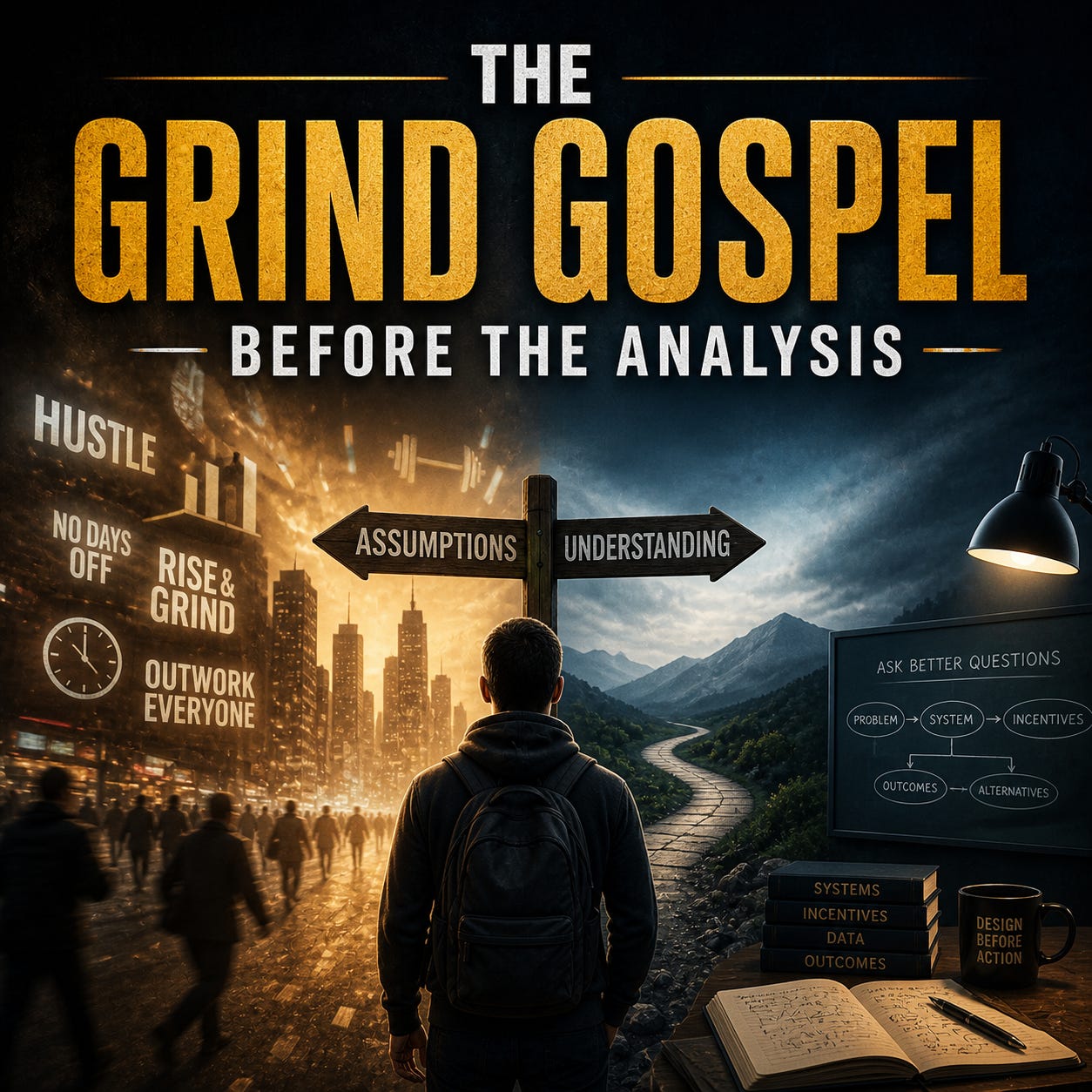
The grind gospel is what happens when that circle collapses. When a person says nobody helped me so I will not help anyone. When the logic that says struggle builds character gets used to justify not doing the work of building a structure. When the discomfort of changing a family’s financial baseline gets mistaken for a values position about what children deserve.
I believed versions of that. I had to examine them carefully before I could move past them. And the examination is what the Grind Gospel series documents, not my personal journey through it, but the belief itself, where it came from, what it costs, and what the evidence actually shows.
This piece is the version underneath. The part that is not analytical. The part that is just honest.
I am 38 years old. My son just turned sixteen. My job is to run my leg of this race well and hand him the baton in better shape than I received it.
That is inside the circle.
Everything else I will let go.
To read the analytical series that grew out of this question, start here: The Grind Gospel — Start Here
Nathaniel Vale | Wisdom Keep