

The Grind Gospel: Full Series Index
Most parents want the same things for their children. Strong character. The capacity to keep going when something is hard. Discipline that holds when no one is watching. Integrity that does not bend under pressure. The ability to recover from failure without breaking. These traits are real, and the desire to see them in a child is not in question.
What is in question is how those traits develop. There is more than one path. One belief, common across very different households, holds that character must be forged through hardship, and that if hardship is not occurring naturally, a parent should manufacture some. Withhold support. Refuse to help. Create artificial scarcity where the resources existed to remove it. Stand back when stepping in was an option. The thinking is that without that imposed pressure, the child will not develop what is needed. That help weakens. That a clear path forward will rob a child of something they were supposed to earn the hard way.
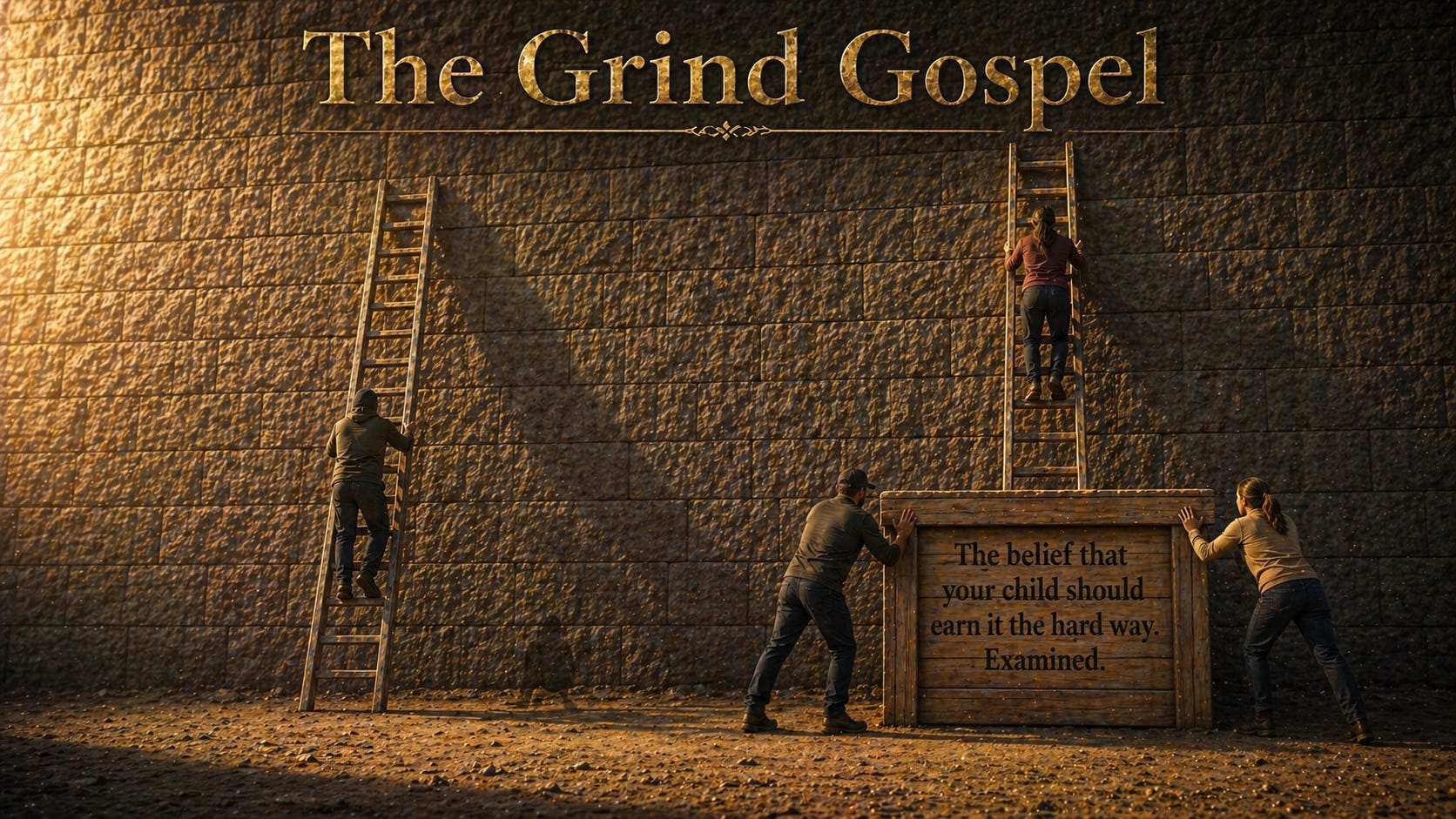
This is the Grind Gospel. It treats the development of character as something a parent must manufacture rather than something that emerges from the friction the world already provides.
There is a parent somewhere right now who has not asked their child about school in six months. Not because they are cruel. Because somewhere deep in their operating system is a belief that caring too much is how you make a child weak. That if you push too hard, ask too many questions, show up too consistently, you will rob that child of the hunger they are going to need later. So they hold back. They watch from a distance. They tell themselves it is discipline. The child reads it as indifference. And indifference is the one thing no amount of hustle can fix.
That is one version of the grind gospel. There is another version that sits inside households with more money and fewer words for what they are doing. The parent who will not pay for college because they did not have anyone pay for theirs. The parent who refuses to co-sign, refuses to help with a down payment, refuses to give any kind of head start because they have decided, without ever examining the decision, that the struggle is the point. That the child needs to earn it the hard way or it will not mean anything. The child graduates into debt, into constraint, into a starting position their parents had the resources to change and chose not to. And the parent tells the story of that child’s struggle with something that looks almost like pride.
This belief does not belong to any one income level. It runs through households with very little and households with quite a lot. It dresses itself up as principle. It calls itself character building. It rarely examines what it is actually building, or what it costs the child who is being built by it.
The Grind Gospel is a 35-post series that takes this belief apart piece by piece. Where it came from. What it is protecting emotionally. Who benefits from it staying intact. And what the evidence actually shows about what children need from the people who are supposed to be in their corner. It is not a series about wealthy families. It is a series about any family making a decision, consciously or not, about how much to give, how much to withhold, and whether either choice was ever really about the child.
Read every post in order using the index below.
If the work this series covers surfaces questions about your own estate structure, trust design, or how to build and transfer wealth with intention, the Estate Planning Blueprint Masterclass addresses the structural layer behind those decisions. Registration is open.
https://lastinglegacypro.com/webinar
GROUP 1: THE PSYCHOLOGY
Where the belief comes from and what it is protecting.


The Grind Gospel publishes every Monday, Wednesday, and Friday on Wisdom Keep. Subscribe below to receive each post as it goes out.
The Estate Planning Blueprint Masterclass is a free one-hour class for families who want to build an estate plan that holds up. It walks through the three things every plan needs to keep probate out, protect children from avoidable conflict, and pass wealth to the next generation cleanly. Readers who recognized the patterns in this post and want to start building the structure that prevents them can register here:
Register for the Masterclass
Readers who would prefer to discuss a specific situation directly can book a free consultation here:
https://lastinglegacypro.com/estate-planning
Nathaniel Vale | Wisdom Keep