

The Grind Gospel Post 2
A series about parents who believe their children must struggle to build character, and what that belief actually costs the family.
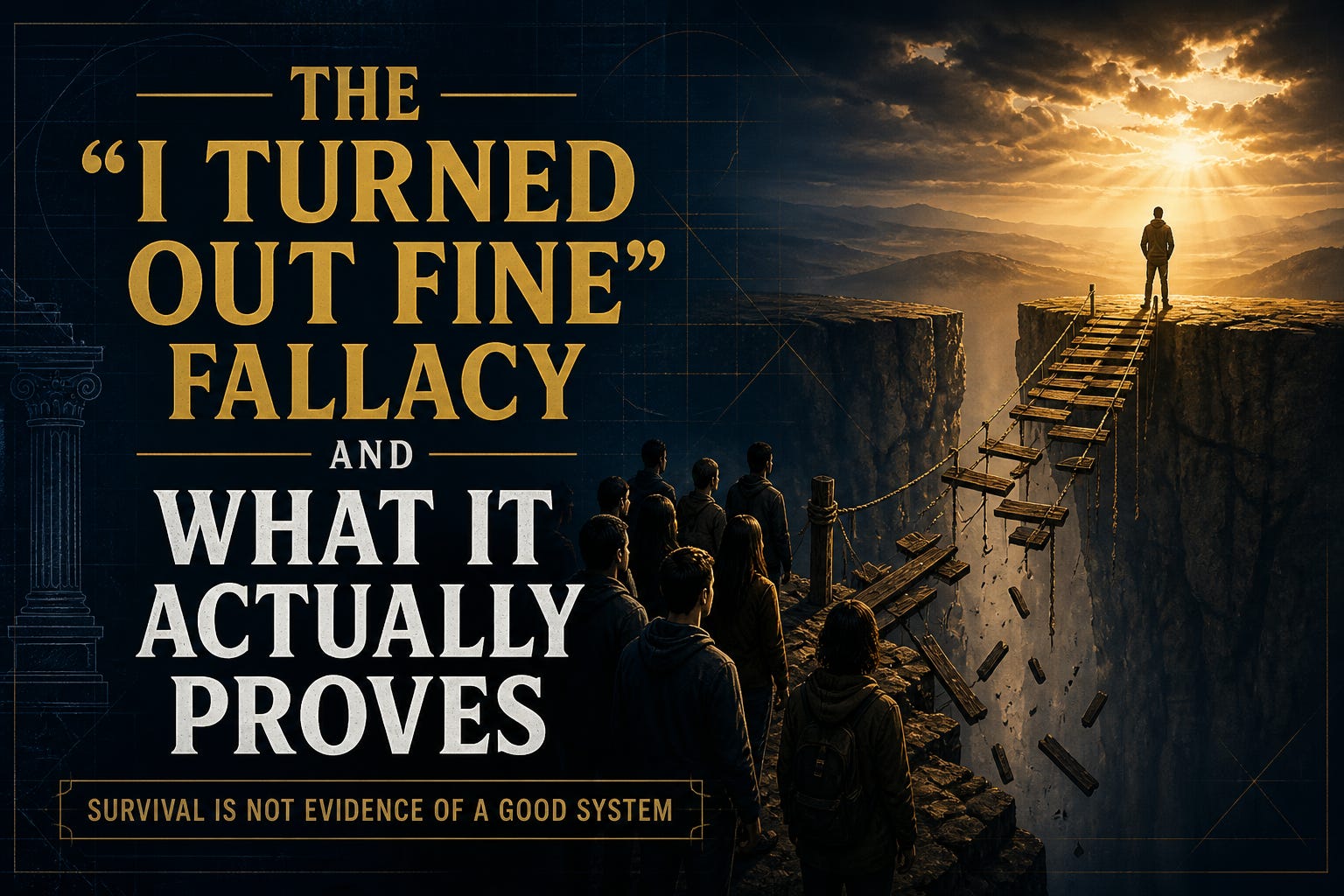
Consider a parent who pushes a child who cannot swim into the deep end of a pool. The reasoning, stated plainly, would sound absurd. But the parent is not operating from cruelty. They are operating from a memory. Somewhere in their past they went into water and came out knowing how to swim. The water taught them. So the water should teach the child.

What the memory edited out is the shallow end. The guiding hand. The slow progression from standing depth to chest depth to the moment they finally went under and came back up on their own. By the time the story gets told, the hand is gone from it. The shallow end is gone from it. What remains is the water and the swimmer and a conclusion about what the water produces. The hand that held them, the progression that built their confidence, the adult who stayed in the water with them until they no longer needed to: none of that made it into the memory because none of that felt like the lesson. The water felt like the lesson.
That is the “I turned out fine” argument. Not a lie. A memory with the scaffolding edited out.
The consequences of operating on this argument run in several directions simultaneously.
The most visible consequence is material. A child whose parent withholds financial support because the parent turned out fine without it enters adulthood carrying higher debt loads, lower capacity for career risk, and fewer options during setbacks. The first decade of adult income goes toward getting to zero rather than building from it. Wealth accumulation starts later. Career decisions that require financial cushion, starting a business, leaving a bad job, relocating for an opportunity, get deferred or abandoned entirely because there is no floor to fall back on. The child works just as hard as a peer who started with more and arrives at midlife measurably behind, not through any deficit of effort or character, but through starting position.
The withheld support is not always financial. A parent who will not acknowledge strong academic performance because they do not want the child to get comfortable, who withholds approval to keep the child striving, sends a message that performance however strong is never sufficient to earn recognition. The child receiving that message does not develop drive. They develop anxiety that performs as drive, and the distinction matters because one is sustainable and the other carries a cost that compounds over time.
The consequence that receives the least attention is the relational one. When a child grows older and understands that the difficulty they experienced was deliberate, ideologically motivated, and based on an assumption the parent never examined, the response is not always gratitude. It is often resentment. Not because the child is ungrateful but because the logical response to having been harmed by someone who believed they were helping is to ask what that says about how much they were valued. The good intention does not absorb the injury. The harm was real regardless of the reasoning behind it.
The consequence that extends furthest is generational. The child who internalizes the framing that their hardship was designed for them carries that story forward into their own parenting decisions. If the hardship made the parent, then ease will unmake the child. The grind gospel reproduces itself. The unexamined assumption moves forward another generation and the compounding disadvantage moves with it.
It gets said at dinner tables, at graduation parties, in the car on the way home from a conversation that did not go the way the child hoped. Someone asks why things have to be this hard. Why there is no help coming. Why the parent who built something substantial is watching from a comfortable distance while the child figures it out alone. The parent leans back slightly, sets down whatever is in their hand, and delivers the line with the confidence of a person stating something self-evident.
“I turned out fine.”
The room accepts it. It almost always does. The argument is treated as though it carries the weight of evidence, because the person making it is sitting right there, clearly fine. The conclusion seems to prove itself. The parent survived a difficult start and became someone worth listening to. The evidence is in the room. The case is closed.
It is not.
The phrase carries the structural confidence of a finding without doing any of the analytical work a finding requires. It is offered as though survival is proof of method, as though the person who came through a fire is qualified to certify the fire as educational. The emotional logic is understandable. The evidential logic does not hold.
What the argument is actually claiming, when stated precisely, is this: the difficult conditions the parent experienced caused the positive outcome the parent achieved, and therefore those same conditions should be applied to the child to produce the same result. That is a causal claim. Causal claims require more than a single data point from the person making the argument. They require understanding of mechanism, isolation of variables, and some accounting for the cases where the same conditions produced different outcomes. “I turned out fine” offers none of that. It offers one person’s outcome as evidence of a universal rule.

The first problem is who is making the argument.
Survivorship bias is the logical error of concentrating on the cases that passed a selection process while overlooking those that did not, producing conclusions that are incomplete by design (Mangel & Samaniego, 1984). The clearest demonstration of this error came from World War II. The statistician Abraham Wald, working with the Statistical Research Group at Columbia University, examined damage patterns on aircraft that had returned from missions. The military’s instinct was to reinforce the areas showing the most bullet damage. Wald identified the error: the planes being analyzed were the ones that returned. The bullet holes on the returning planes showed where a plane could take a hit and still fly home. The planes that did not return were the ones that had taken hits somewhere else. Wald proposed reinforcing the areas where the returning aircraft were unscathed, inferring that planes hit in those areas were the ones most likely to be lost.

The parent who turns out fine after a difficult start is the returning plane. They are at the table making the case for the conditions because they survived them. The people who started from the same conditions and did not turn out fine are not at the table. They are not invited to the graduation party. Their outcomes are not included in the evidence the parent is presenting, not because they are rare but because they are not visible in the same way. The sample the “I turned out fine” argument draws from is composed entirely of survivors. A conclusion drawn exclusively from survivors about what made them succeed is not a conclusion about the conditions. It is a conclusion about the people willing and able to make the argument.
The second problem is what else was present.
When someone turns out fine after a difficult start, the difficult start is almost never the only variable in the story. Research on resilient outcomes in children exposed to adversity consistently finds that positive adaptation is produced not by the adversity itself but by protective factors surrounding it: positive relationships with caregivers, social support structures, individual traits such as self-esteem and self-regulation, and engagement with community institutions such as schools or organized groups (Whittle et al., 2019). A systematic review of protective factors following childhood adversity found that increased social connection, access to education, and the cultivation of resilient personality traits in early life were the variables associated with better adult outcomes, not the hardship itself (BJPsych Open, 2023).

The parent who turned out fine has identified the difficult start as the cause because it is the most visible and most personally meaningful variable in the story. The hardship was felt. It was lived through. It left a mark. What did not make it into the story is the career break that came through a person, the introduction that preceded them into the room, the relationship that turned into the meeting that became the contract. The investment that happened to be right, not because of superior judgment but because of timing in a market nobody controls. The mentor who recognized a younger version of themselves and said one line on one afternoon that stayed with the person for twenty years. The team of people working on behalf of the self-made millionaire, without whose leverage the million would never have been reachable by one person alone. The parent who quietly kept the lights on during a hard year, or let the adult child move home, or paid for the semester that made the difference, and never called it a gift because that was just what family did.
These variables are present in most survival stories and absent from most telling’s of them. Not because the parent is being dishonest. Because the hardship is the part that required the most of them, and what required the most of them feels like what produced the most in them. There is also a second reason they get edited out: crediting them makes the achievement feel contingent on something outside the self. If the mentor made the difference, does the hard work still count. If the timing on an investment changed everything, was the outcome really earned. Most people would rather the answer be yes, and so the invisible factors disappear from the account.
Visibility is not the same as causal weight. The difficult start cannot be isolated as the mechanism that produced a capable adult when the outcome had a dozen other contributing factors that never get named.
The third problem is the question that cannot be asked.
There is no version of the parent’s life in which the difficult conditions were removed and everything else was held constant. No parallel track where the same person grew up with more support, fewer financial constraints, and a better starting position, and then arrived somewhere at fifty to compare notes with the version who did not. The parent genuinely does not know how they would have turned out under different conditions. That version of their life does not exist and cannot be consulted.
The “I turned out fine” argument assumes the answer to a question it cannot pose. It assumes that the difficult start was necessary rather than merely present. That without it something essential would have been missing. That the outcome was forged by the hardship rather than achieved despite it. None of those assumptions can be tested. The parent has one life, one set of conditions, one outcome. That is not a study. It is a single data point with a very compelling narrator.
What the fallacy asks of the child is worth naming directly.
It asks the child to accept a harder starting position as something designed for their benefit. To trust that the conditions producing their difficulty are the same conditions building their future capability. To absorb a parenting decision made for reasons the parent may not have examined as though it were a deliberate gift with a measurable return.
Research on how parental narratives shape children’s internalized beliefs is instructive here. From early childhood, children build their understanding of their own experiences through conversations with their parents about past events. When parents engage in detailed discussions that provide causes, explanations, and emotional framing for what children go through, children absorb those frames as part of their own narrative identity, the internalized story they carry about who they are and what their experiences meant (Fivush et al., 2006, as cited in ScienceDirect, 2025). The child who is told, directly or indirectly, that their difficult conditions were designed for their growth does not receive that message neutrally. They internalize it as a story about themselves: that they required hardship to become capable, that ease would have made them less. That story follows them. It shapes how they understand their own children’s needs. It is how the assumption reproduces itself without anyone intending to reproduce it.
The child receiving that framing is not receiving wisdom. They are receiving an untested assumption wrapped in the authority of a parent who turned out fine and is therefore certain about why.
“I turned out fine” is true. The parent sitting at the table is fine. The evidence for that specific claim is right there, clearly fine, making the argument. Nothing in this post disputes that outcome or diminishes what it took to get there.
What the argument does not establish is that the difficult conditions caused the fine outcome. It does not establish that the same conditions will produce the same result for the child. It does not establish that the conditions were necessary rather than simply present. It does not account for the survivorship problem, the confounding variables, or the counterfactual that cannot be tested. It does not account for the people who started from the same place and are not at the table.
It is a statement about the parent. It is not a prescription for the child. Those are different things, and the distance between them is where a great deal of unnecessary difficulty gets justified and passed forward as love.
What changes when a parent recognizes this is not the conclusion they reach. It is the quality of the question they start asking.
The answer is not to give without structure. A child who receives everything without context, without expectation, and without any relationship between effort and outcome is not being set up for capability. They are being set up for a different kind of problem. The grind gospel and its overcorrection are both blunt instruments applied without examination. Neither is a substitute for the harder work of evaluating what a specific child in a specific situation actually needs.
Different children require different approaches. A child who is naturally risk-averse needs different conditions than one who is naturally reckless. A child who is building genuine confidence needs different feedback than one who is avoiding the work entirely. A parent who is naturally withholding and a parent who is naturally permissive will each bring their own blind spots to these decisions. There is no universal template that resolves this cleanly.
What this series is arguing against is not generosity. It is the absence of thought. The parent who withholds because the grind gospel told them to, without ever asking whether the withholding serves this child in this situation, is not parenting deliberately. They are operating on an inherited assumption and calling it a philosophy. The parent who gives without structure for the same reason is making the same error in the opposite direction.
The question worth sitting with is not how much to give or how much to withhold. It is whether the decision being made was actually made, or whether it was simply inherited, and whether the child in front of the parent was actually seen, or whether they were being fit into a template built from someone else’s memory.
The Grind Gospel runs as a series. To read the series in order, start here:

The dinner table moment in this post is not hypothetical. Most people have been in that room or been the child sitting across from someone certain their survival was the lesson. Readers who recognized something in this post, a memory, a conversation, a version of this they lived through on either side of it, are welcome to name it in the comments. This series is built around a belief most families have never examined out loud. The comments section is where that examination starts.
If this raised questions about what your own family structure actually needs, the Estate Planning Blueprint Masterclass is the next step. It is free and it goes where this post points. Register here: https://lastinglegacypro.com/webinar
Prefer to talk through your specific situation directly? Book a free consultation: https://lastinglegacypro.com/consultation
Nathaniel Vale | Wisdom Keep
REFERENCES
BJPsych Open. (2023). Protective factors for psychosocial outcomes following cumulative childhood adversity: Systematic review. BJPsych Open. https://www.cambridge.org/core/journals/bjpsych-open/article/protective-factors-for-psychosocial-outcomes-following-cumulative-childhood-adversity-systematic-review/03C2C8E7B024392F3D40FB85A59C470A
Fivush, R., et al. (2006). Elaborative reminiscing with children: Family narratives and self-understanding. As cited in: ScienceDirect. (2025). Contribution of narrative identity and future autobiographical memories integration in the self on meaning and purpose in children. https://www.sciencedirect.com/science/article/abs/pii/S0885201424001217
Mangel, M., & Samaniego, F. (1984). Abraham Wald’s work on aircraft survivability. Journal of the American Statistical Association, 79, 259–267.
Whittle, N., et al. (2019). What factors are associated with resilient outcomes in children exposed to social adversity? A systematic review. BMJ Open. https://pubmed.ncbi.nlm.nih.gov/30975671/
Williamson, A. A., et al. (2023). A systematic review of positive childhood experiences and adult outcomes: Promotive and protective processes for resilience in the context of childhood adversity. PMC. https://pmc.ncbi.nlm.nih.gov/articles/PMC10528145/
By Nathaniel Vale | Wisdom Keep