

The Grind Gospel - Post 4
A series about parents who believe their children must struggle to build character, and what that belief actually costs the family.
Class guilt is one of several psychological postures the Grind Gospel series examines. The series argues that the structures keeping most families inside their current generational position are not financial. They are psychological, inherited, and operating below the level of stated belief. Naming them precisely is the first step in deciding whether they continue to run the family's decisions.

Long before there was a daughter named Hannah, there was a Sunday afternoon when Roy stood in his parents’ driveway with the keys to a 1996 Toyota Corolla and a cardboard box that contained everything that mattered to him at twenty-eight, which was not much. He had taken a job in a town an hour and a half away. His parents had not asked him to leave. He had not asked their permission. He had told them at dinner two weeks earlier that he had been offered the position and was going to take it, and his father had nodded and said that was the right call, and his mother had not said anything at all.
The town Roy was leaving had a closed paper mill and a steady decline that had been going on for fifteen years and would continue for fifteen more. The town Roy was going to had a small downtown and an insurance agency that needed someone who could run claims and be patient with the older clients. The pay was forty thousand a year, which was eight thousand more than Roy was making at the warehouse job he was leaving, and it came with health insurance for the first time in his adult life.
The drive took an hour and forty minutes. By the time Roy reached the apartment he had rented on the second floor of a duplex in the new town, the box of belongings had shifted in the trunk and the bottle of his father’s homemade wine, the only thing his mother had pressed into his hands as he loaded the car, had not survived the trip. Roy sat in the parking lot for a long time before going up.
That was the first move. There were others. By thirty-five Roy was making ninety thousand a year. By forty he had bought a modest house in the new town. By fifty he had paid most of it off. By sixty he had it paid off entirely and a retirement account that would carry him through his eighties.
His parents visited the new house exactly once. His mother said it was very nice. His father said the trim work in the kitchen was uneven and could be redone. They drove home that afternoon. They did not visit again. There was no conflict. They were just visibly uncomfortable in the house, and they did not know how to be in it, and Roy understood without anyone saying so that the visit had been a kindness rather than a pleasure.
When Roy’s father got sick at seventy-eight, he came to live with Roy for the last two years of his life. The father slept in the smaller bedroom and refused to use the dishwasher because, as he said more than once, they had not had one when they were raising Roy and he was not going to learn a new way of doing dishes at his age. He died in the spring. The funeral was back in the old town. Most of the people there were people Roy had known as a child and had not seen in twenty years. Several of them looked at Roy carefully and said it had been a long time, and a few of them did not say anything at all.
The inheritance was forty-six thousand dollars and his father’s tools. Roy still uses the tools. The forty-six thousand sits in an account Roy has not touched in eleven years, although by now, with quiet compounding, it is worth closer to seventy-eight thousand.
The story Roy tells about himself, when he tells it, is that he worked hard and was lucky and got a foot in the door at a place that turned out to be a good place. The story is true. Most of what Roy has came from showing up for thirty-four years and doing the work and not making mistakes that mattered. The ascent was earned.
What Roy has never been quite able to tell himself, in any version of the story, is whether the leaving was earned the same way. He was not pushed out of the old town. The old town did not lose him to opportunity in the way an outside observer would describe it. Roy chose to leave because the alternative was staying, and staying had a shape to it that Roy did not want to take. He has spent thirty-four years living a life that the people he grew up with would describe as nicer than theirs. He has spent thirty-four years not quite knowing what to do with the fact that they are not wrong.
This is the unspoken background of the conversation Roy is about to have with his daughter Hannah, although neither of them sees it that way and Hannah is not calling about anything related to it.
She is calling about a house.
Hannah is thirty-two. She is a graphic designer. She has been saving for a house for eight years, working a steady job that pays well enough to make the saving possible but not so well that it has been quick. She has ninety-two thousand in savings, of which she has earmarked seventy-eight thousand for a down payment and the rest as a small reserve. She has been pre-approved by her bank. The house she has been looking at hardest is in a suburb thirty minutes from where Roy lives. It is in a better school district than Roy’s neighborhood. It has three bedrooms and a yard. The asking price is four hundred and eighty-five thousand.
The math is tight. Hannah’s down payment will cover seventeen percent of the purchase price, which means she will need private mortgage insurance, which adds a few hundred dollars a month to the payment. The closing costs are running about fourteen thousand. After all of that, her reserve will be effectively gone. Hannah is asking Roy if he could help with the closing costs only. Not the down payment. Fifteen thousand, against a written agreement to repay him over three years at no interest. She has the math worked out. She has talked to the bank about it. She is calling Roy not because she needs the money to get into the house, but because the closing-cost help would mean she does not have to deplete her reserve in the same month she takes on a mortgage.
Roy listens. Roy does not say no. He says he wants to think about it. He asks her about the property tax in that suburb, which he already knows is higher than where he lives. He asks her whether she has looked at houses on his side of town, where the schools are not as strong but the prices are. He frames the questions as practical. He is aware, on some level, that he is doing it to delay rather than to gather information.
The call ends with Roy saying he will get back to her in a few days. After Hannah hangs up, Roy sits in his living room for a long time. The forty-six thousand from his father, now closer to seventy-eight thousand, is in an account he can move from in roughly forty seconds. The check would not move his retirement timeline by any meaningful amount. The numbers are not the issue. The numbers have not been the issue at any point in the conversation.
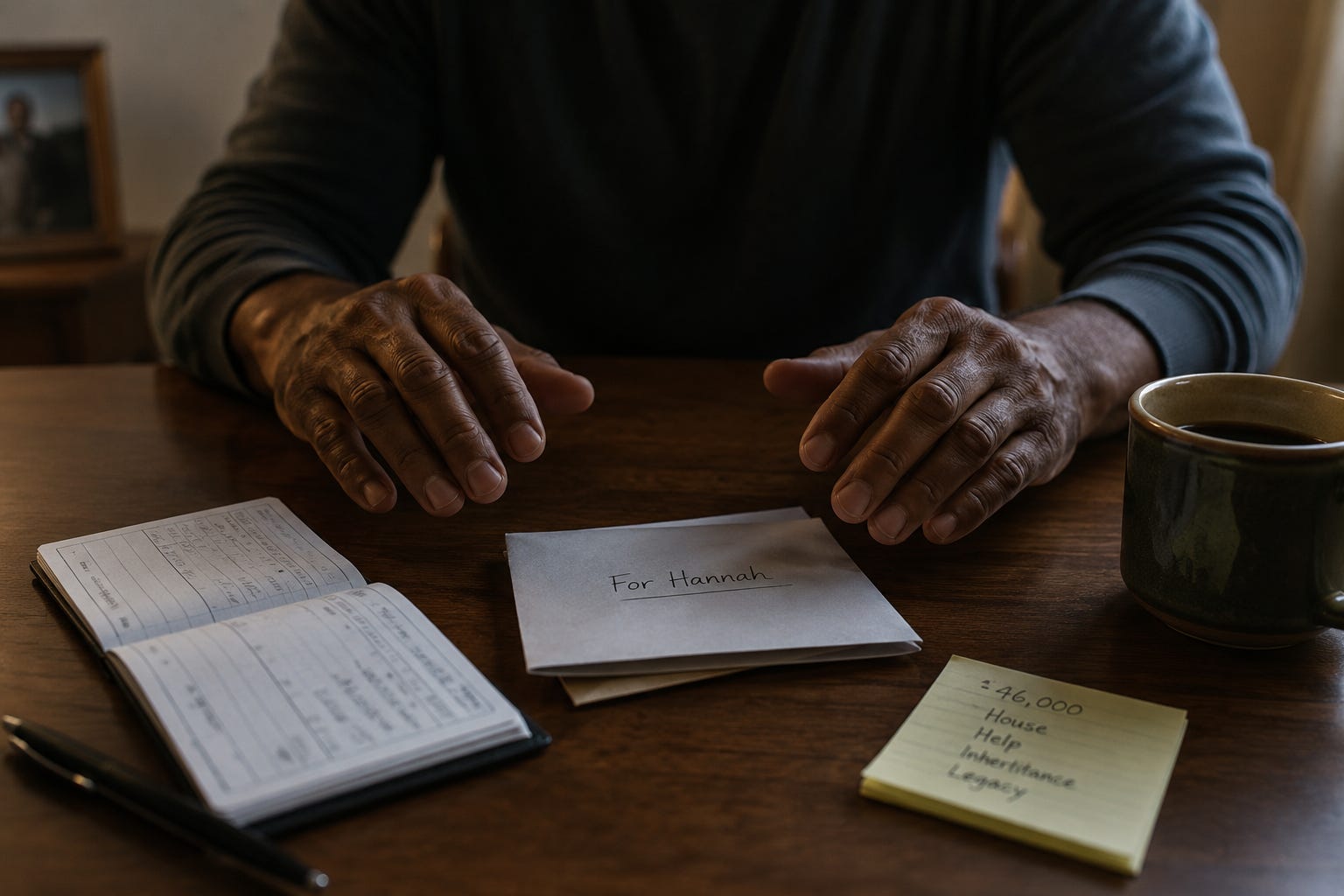
What sits with Roy after the call is not the question of whether Hannah deserves the help. He thinks she does. What sits with him is that the houses Hannah has been looking at are nicer than any house he ever lived in. They are nicer than any house his parents ever lived in. They are nicer than any house the people who came to his father’s funeral ever lived in. And the thought of writing the check that puts his daughter in one of them, deliberately, with money he himself never quite knew what to do with, sits in his chest in a way he cannot name.
That feeling is what this post is examining.
It is not pride. Roy is not protecting an image of himself as someone who built what he has through his own work. It is not principle. Roy is not arguing, even to himself, that Hannah needs to develop character through struggle. It is not fear of dependency. Hannah has not asked for ongoing support. She has asked for a one-time contribution to closing costs against a written repayment plan.
It is something quieter and harder to name. It is the residual discomfort of a man who climbed a ladder, looked back, and never fully resolved his feelings about the rung he started on. He has never asked himself whether his ascent was a betrayal of where he came from. He has never had to. The question only surfaces now, in the moment of being asked to sign a check that would extend the climb to a generation he is responsible for launching.
That discomfort has a name. It is class guilt, and it operates on a logic entirely separate from the beliefs the previous posts in this series have examined.
Class guilt is the internalized sense that economic mobility above one’s origin is, if not wrong exactly, then suspect. It requires justification. It creates distance between the person who moved and the people who did not, and that distance is felt as a kind of betrayal even when no betrayal was intended and no one was left worse off by the departure.
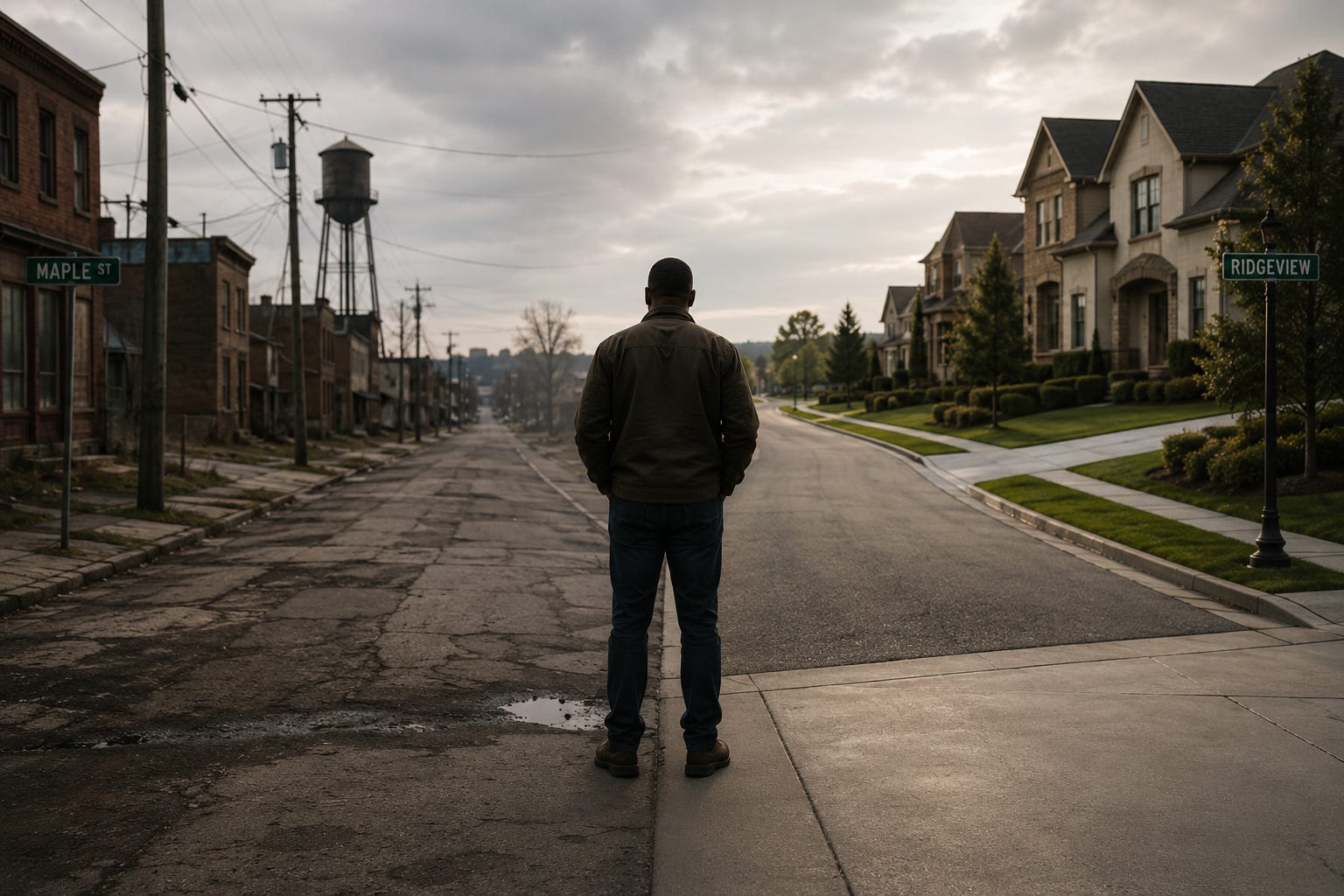
For families that built their identity inside working-class or lower-middle-class communities, money carries social meaning that does not disappear when the bank balance improves. Those communities have strong cultural investments in solidarity, in not acting as though one has become something different from the people around them, in the specific social contract that keeps a tight-knit community functional: we are all in this together, and the person who acts like they are not is no longer quite one of us.
Economic mobility breaks that contract. Not maliciously. Not deliberately. But the break is real. The person who earns more, moves somewhere else, sends children to different schools, lives differently than they were raised is no longer fully inside the community that raised them. The guilt is the internal accounting of that distance. It is the feeling that something was taken in the getting of something better.
Roy felt the break the first time his parents visited his new house. His mother said it was very nice. His father criticized the kitchen trim. They did not visit again. Nothing was said. Nothing needed to be said. The visit was the moment the distance became real, and Roy spent the next thirty-four years not knowing what to do with the fact that the distance had been real before that visit too. It was the visit that made it visible.
The doubling works like this.
Roy crossed a line once, by succeeding economically beyond what his origin made probable. That crossing required justification to the community he left behind, or at least a sustained internal explanation for why the departure was acceptable. Giving Hannah a significantly better starting position than Roy had feels like endorsing the departure rather than surviving it. Roy survived the distance. Giving Hannah a different origin entirely feels like choosing it. And choosing it, deliberately, with seventy-eight thousand dollars sitting in an account Roy does not even use, feels like the definitive statement that the origin was not good enough.
That is not a financial decision. It is an identity decision. And it is being made on behalf of a child who did not ask to be born into the parent’s unresolved relationship with their own ascent. Hannah did not move out of the old town. Hannah did not leave anyone behind. Hannah was born into the new town as a fact of her own life, and the suburb she is now looking at houses in is, to her, the next reasonable step. The moral weight Roy is feeling is not weight Hannah inherited. It is weight Roy has carried for thirty-four years and is now, without being able to articulate it, asking Hannah to carry too.
There is one more layer running underneath the hesitation, and it is the layer Roy is least able to name.
Roy already knows what happens when the climb succeeds. He lived through it. His parents visited his new house once and never returned. The visit was civil. The kitchen trim was criticized. The distance had been real before the visit, and the visit only made it visible. Roy has spent thirty-four years carrying the quiet recognition that economic mobility cost him a relationship with the people who raised him. Not because anyone got angry. Not because anyone said anything. Because the climb produces a distance that no amount of love quite reaches across.
What Roy cannot say, even to himself, is that he is afraid of the same distance forming between him and Hannah. If he writes the check that puts Hannah in the better suburb, he is helping her into a house he may, twenty years from now, sit inside the way his father sat inside Roy’s. Uncomfortable. Not knowing what to do with the rooms. Saying the trim work could be redone, because criticizing the trim work is an easier thing to do than admit the distance is now between him and someone he loves.
That fear is not selfish. It is not Roy putting his comfort ahead of his daughter’s future. It is the residue of a wound he has carried for three decades, still tender enough to flinch when the same shape of decision comes around again on the other side. The check is not just an economic act. The check, in some quiet calculation Roy is making below the level of awareness, is a vote for the very dynamic that produced his own loss.
This is the specific fear class guilt protects against, and the specific reason class guilt is so hard to dislodge with argument. The argument can be correct in every particular and the fear remains. The fear is older than the argument. It was formed before Roy had the language to examine it.
The cost of class guilt is not only the immediate help withheld. The cost is the psychological inheritance.
A child who grows up watching a parent feel guilty about money, about having more than the people they grew up with, about giving advantage that was not given to them, absorbs that guilt as a relationship with money before they ever make a financial decision of their own. They learn that having more than your origin is uncomfortable. That giving your child more than you had is somehow presumptuous. That restraint is a form of loyalty, even when the people it is supposedly loyal to are not asking for it and are not helped by it.
The guilt compounds across generations as reliably as assets would have if the guilt had not constrained them.
This is the part of the dynamic that operates whether or not Roy eventually writes the check. Even if he calls Hannah back in three days and says yes, the hesitation has already happened. Hannah has already heard the questions about property taxes and the suggestion that she look at houses on Roy’s side of town. She has already absorbed the message that the help is something to be reluctantly granted rather than something that flows naturally from a parent who has the means and a child who has done the work. The check, if it is written, will arrive with the residue of the hesitation attached to it. And if Roy does not write the check, Hannah will close on a less-good house, lose her reserve, take on PMI for a few extra years, and remember for the rest of her life that the help was there and was not given and the reason was something her father could not name.
Either outcome transmits. The hesitation is the transmission. Hannah will absorb a model of money that says: we have, but we do not give from what we have, and we feel uncomfortable with what we have, and the discomfort is the proper posture. When Hannah herself becomes a parent, that posture will sit in the room with her, doing its work without her noticing, the same way Roy’s parents sat with him.
The reframe that matters here is not about abandoning where one came from. A person can hold deep pride in their origin, maintain genuine connection with the community that shaped them, and honor the values carried forward from a working-class upbringing, and still give their child a better starting position. These are not in competition.
The people Roy grew up with are not better positioned because Hannah starts from where he started. The old town is not served by Roy’s grandchildren beginning where Roy’s grandparents began. That restraint does not rebuild the closed paper mill. It does not bring back the people Roy did not stay in touch with. It only ensures that the next generation begins from a point Roy already passed through, carrying a guilt that was never theirs to carry and a brake that was never theirs to inherit.
Solidarity with a community of origin is a legitimate and meaningful human value. Expressing that solidarity through financial constraint imposed on a child who had no vote in where she was born is not an act of loyalty. It is a misapplication of one.
This is the part of the analysis that, on its own, does not move Roy. He has heard versions of it before. He has watched friends move further than he has, watched cousins make decisions about their own children that Roy would not have made, and the watching has not changed anything in him. The argument is correct and the argument is not enough. Roy has been inside the box for thirty-four years, and accurate descriptions of the box do not unlock it. Something has to happen from the outside.
What happens to Roy, in this story, is a phone call he was not expecting.
It comes a week after the call about closing costs, which Roy still has not returned. Hannah is on the line again, and at first Roy thinks she is calling to follow up on the fifteen thousand. She is not. She tells him she is pregnant. Eleven weeks. The doctor says everything looks normal so far. She wanted Roy to know.
Roy says the things a person says in that moment. He is happy for her. He is happy for her partner. He asks how she is feeling. He says he loves her, which he does not say often, and the saying of it surprises both of them. The call lasts longer than the previous one.
After Hannah hangs up, Roy stands in his living room. The seventy-eight thousand dollars is in the same account it was in the previous week. The school district reports for the suburb Hannah is moving to are accessible on his phone in roughly four taps. He pulls them up. He looks at the test scores and the graduation rates and the per-pupil funding. He looks at the same numbers for the district his own house sits in. The difference is not subtle. Roy has known this for years without ever quite letting himself look at it. Looking at it now, with a grandchild eleven weeks along, the numbers mean something different than they did the week before.
The grandchild has not been born into Roy’s old town. The grandchild has not been born into Roy’s old class. The grandchild will not have to leave anywhere to arrive somewhere better, because the grandchild is already arriving in the somewhere better. The frame Roy has been carrying, the one his father carried before him and his grandfather before that, has nothing to say about the grandchild. The grandchild is outside the rules.
And once Roy can see that the grandchild is outside the rules, he can see, for the first time, that Hannah was outside the rules too. Hannah was just inside them long enough that Roy never noticed she did not belong there. She was born into the new town. She did not climb out of anything. The guilt Roy has been mistaking for principle was always a story about Roy. It was never about her. It was never about anyone but Roy.
He calls Hannah back the next morning. He tells her the closing-cost help is coming. He tells her not to repay it. He tells her to keep her reserve. The call lasts eight minutes. When it ends, the seventy-eight thousand has dropped to sixty-three thousand and Roy is sitting in his living room again, but the room sits differently around him than it did the week before.
What Roy notices, over the next few days, is that the sixty-three thousand still sitting in the account is not for him.
He has known this for eleven years. The account has been sitting there the whole time. But what Roy now understands, because the grandchild has rearranged the frame, is that the sixty-three thousand was never meant to stay where it is. It was meant to keep moving. His father gave him forty-six thousand. The forty-six thousand became seventy-eight thousand. Some of it has now become a closing-cost contribution to a house his grandchild will grow up in. The rest is supposed to keep going. To Hannah, when she needs it. To the grandchild, when the grandchild is old enough to need it. To the grandchildren Roy does not yet know are coming. Possibly to great-grandchildren Roy will never meet.
The question Roy now finds himself sitting with is not whether to give. The question is how to make sure the giving keeps working after he stops being the one doing it. How to set up a structure that protects the sixty-three thousand and whatever it grows into, so that decisions made by a future Hannah, or a future Hannah’s child during a difficult year, or a future spouse during a divorce that has not happened yet, do not undo what Roy is now beginning to think of as a position rather than an inheritance.
That question has an answer, and the answer is not something Roy can build by himself with a checkbook and a savings account. It is a legal structure. And it is the structure the rest of this series, and the work that supports the series, exists to help families like Roy’s understand and put in place.
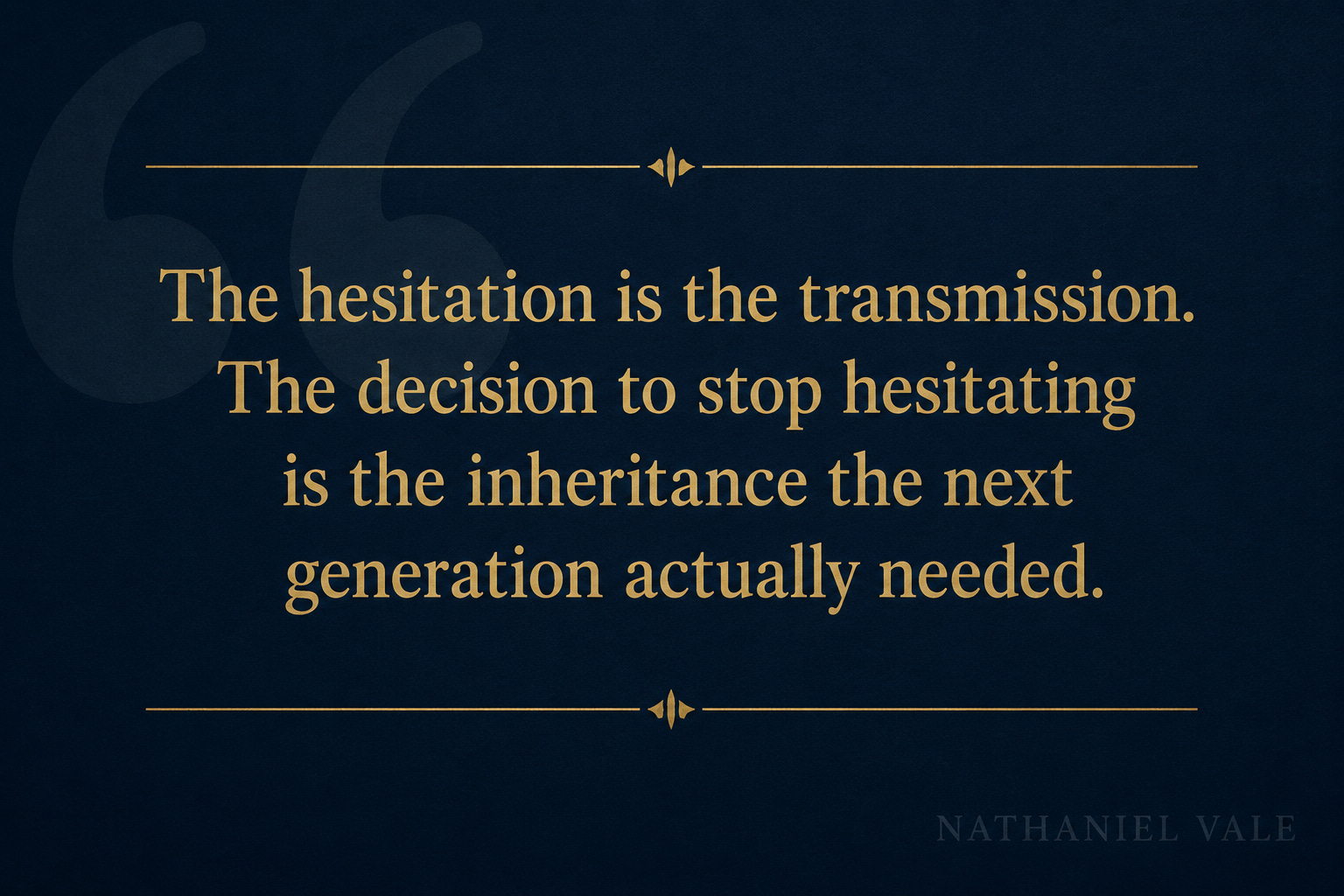
What Roy did, in the end, was not solve his class guilt. He carried the same complicated relationship with his own ascent the next morning that he had carried the morning before. The forty-six thousand from his father is still threaded through with whatever was unsaid between Roy and the people at the funeral. The kitchen trim his father once criticized is still uneven. None of that resolved.
What changed was that Roy stopped letting an unresolved feeling, sitting where he could not name it, run a financial decision it was never qualified to make. The grandchild gave him the angle. The angle gave him the action. The action started a new story about what the money is for and where it is going.
That is the work this series is naming. Not the resolution of the guilt. The decision, made deliberately, to stop letting the guilt be the deciding voice.
This post is part of The Grind Gospel, a series about parents who believe their children must struggle to build character, and what that belief actually costs the family. To read the series in order, start here

The comments section is open. This series is built around what families do not say out loud. The comments are where that changes.
Readers who want to follow the rest of the series can subscribe to Wisdom Keep here. Each post lands in the inbox the morning it publishes, in series order, with no extra effort required to keep up
The Estate Planning Blueprint Masterclass is a free one-hour class for families who want to build an estate plan that holds up. It walks through the three things every plan needs to keep probate out, protect children from avoidable conflict, and pass wealth to the next generation cleanly. Readers who recognized the patterns in this post and want to start building the structure that prevents them can register here:
Register for the Masterclass

Readers who would prefer to discuss a specific situation directly can book a free consultation here:
https://lastinglegacypro.com/consultation
Nathaniel Vale / Wisdom Keep