

The Hidden Truths series Post 02
The Hidden Truths examines the gap between what families believe their estate plan will do and what the legal system actually does after a death. Each post follows one family through one specific failure that planning could have prevented.
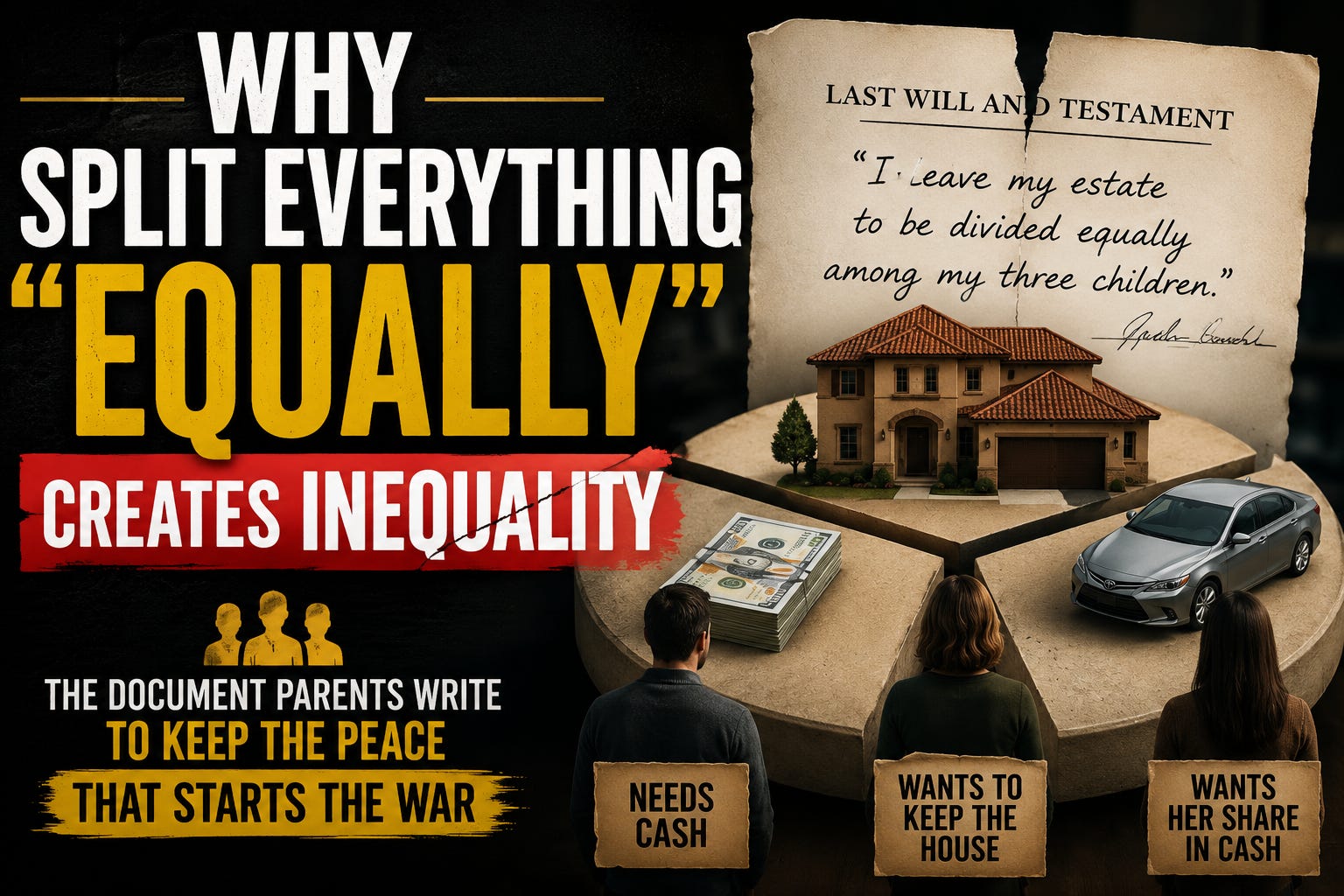
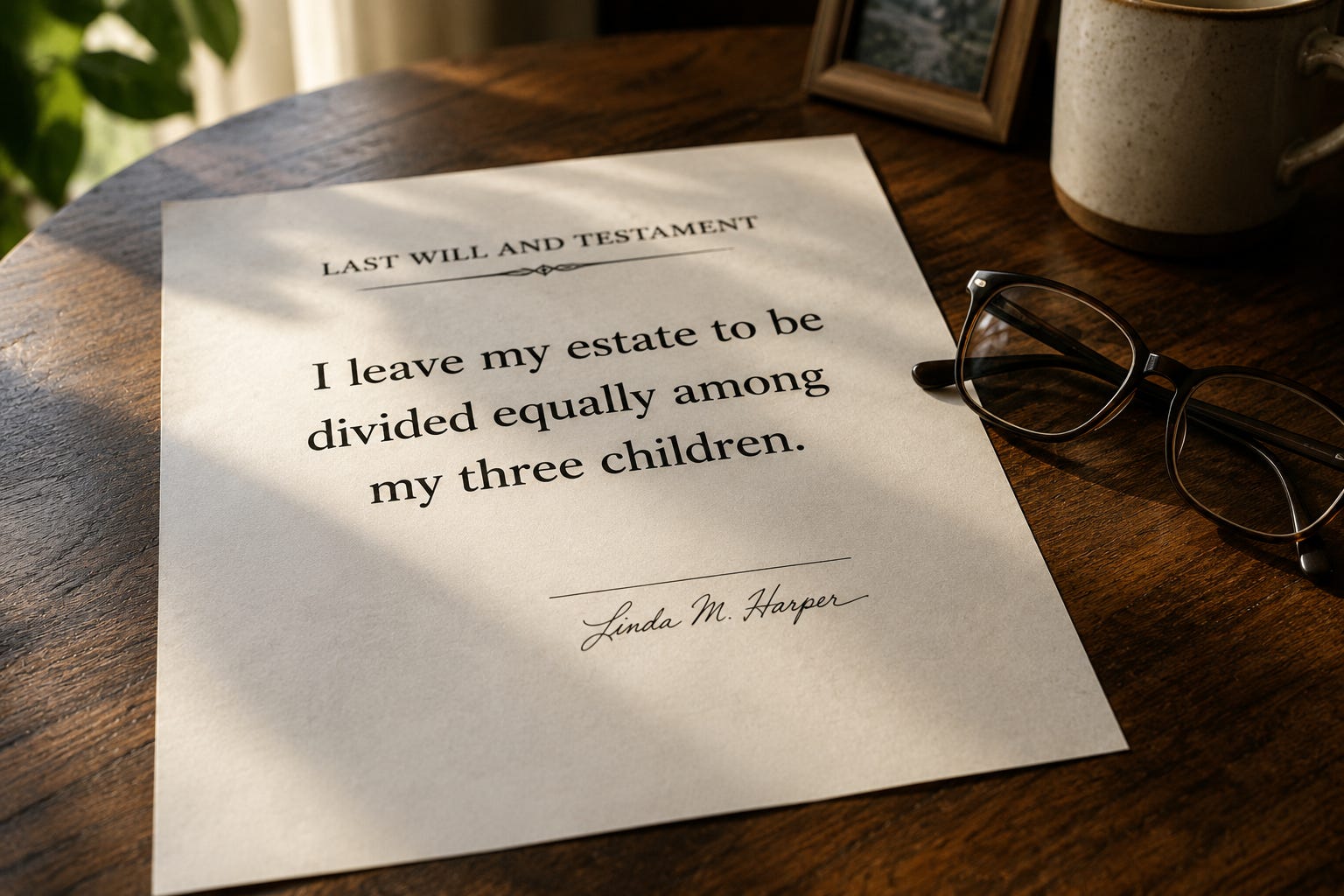
Teresa was reading the will for the fourth time when she called her brother. It was six weeks after their mother’s funeral, and the entire instruction was a single sentence:
“I leave my estate to be divided equally among my three children.”
The estate was a $420,000 home in Scottsdale, $14,200 in checking, and a 2019 Camry. Teresa, fifty-one, was the only sibling living nearby and had been her mother’s primary caregiver for three years. David, forty-seven, was five months out of work and behind on his own mortgage. Renee, forty-three, had lived in Denver for eight years and had no plans to return.
Three children in three different financial positions with three different relationships to the house. One instruction that treated them identically.
Two things their mother could have done while she was alive would have changed everything that happened after she died. Neither one was complicated. Neither one would have taken more than a few hours of her time. Together, they would have replaced the eleven months of dispute that followed her death with the clean transfer their mother had wanted.
She did neither.

The first thing was a conversation. One conversation, with all three of her children in the room together, while she was still alive. The conversation would have surfaced what each child believed about the house and what each child wanted from the estate. It would have surfaced the things each of them had quietly assumed.
Because each of them had assumed something. David, looking at his own mortgage and the five months of unemployment, had assumed the estate would resolve into cash through a sale. He never said it out loud, because no one ever asked him. Teresa, who had been driving over to the house twice a week for three years, had assumed that her connection to the property meant she would be able to keep it. She never said it out loud, because no one ever asked her. Renee, two states away and content with her life in Denver, had assumed her share would arrive in cash and require nothing from her. She never said it out loud, because no one ever asked her.
Three different assumptions, each made in private, each unexamined by the person holding it, each in conflict with the others. Their mother could have surfaced all three in an hour. She could have asked each of them what they wanted, what they could realistically hold, and what they were prepared to do for the others. The conversation would have been awkward. It would not have been impossible.
The conversation produces information that the document cannot produce on its own. It produces a shared understanding among the people the document will affect. Teresa would have known David needed cash. David would have known Teresa wanted to keep the house. Renee would have understood the position the other two were in. Their mother would have known what each of her children actually needed, and she could have built a plan around that knowledge instead of around the guess that “equal” would settle everything.
The lack of that conversation is the central failure. It is the reason David spent six weeks after the funeral assuming the estate was about to convert into the cash he urgently needed. It is the reason Teresa spent the same six weeks assuming she would be able to stay in the house she had been managing for three years. Two siblings, in the same family, holding two incompatible expectations, neither one of them aware of the conflict because no one had ever put both expectations in the same room.
An hour at the kitchen table while their mother was alive would have made those six weeks impossible.
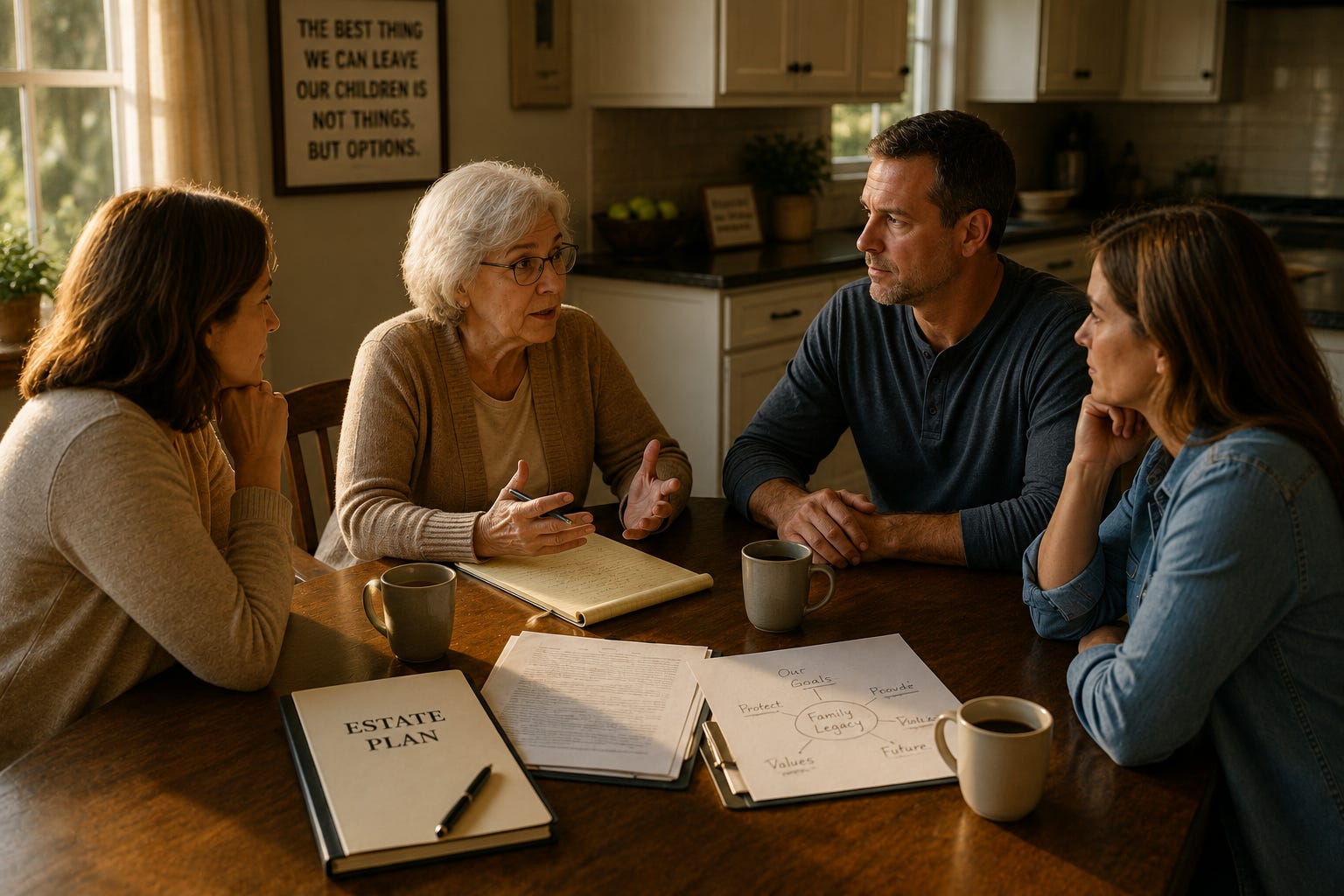
A conversation alone does not finish the work. Verbal understandings among family members are not legally binding, and they exist only in the memories of the people who had them. Time changes those memories. Time changes the people who had them. Spouses and partners join the family who were not part of the original conversation. Financial pressures emerge that nobody anticipated. None of this requires anyone to act in bad faith. It only requires the years between the conversation and the death to do what they always do.
The structural backup is a revocable living trust. With the house titled in the trust during their mother’s lifetime, the property does not enter probate after her death. There is no public court process to contest, because there is no court process at all. The trust’s instructions, drafted from the conversation, execute on the trust’s timeline through the trustee their mother named.
The asset cannot be held up by anyone withholding a signature, because no signature beyond the trustee’s is required. There is no probate contest available, because the asset is not in probate. A challenge to the trust itself remains possible through a separate civil action, but the legal threshold for invalidating a properly executed trust is substantially higher than the threshold for contesting a will, and such challenges rarely succeed.
The trust does not produce the agreement. The conversation produces the agreement. The trust holds the agreement in place across the years that follow, when memories soften and circumstances change.
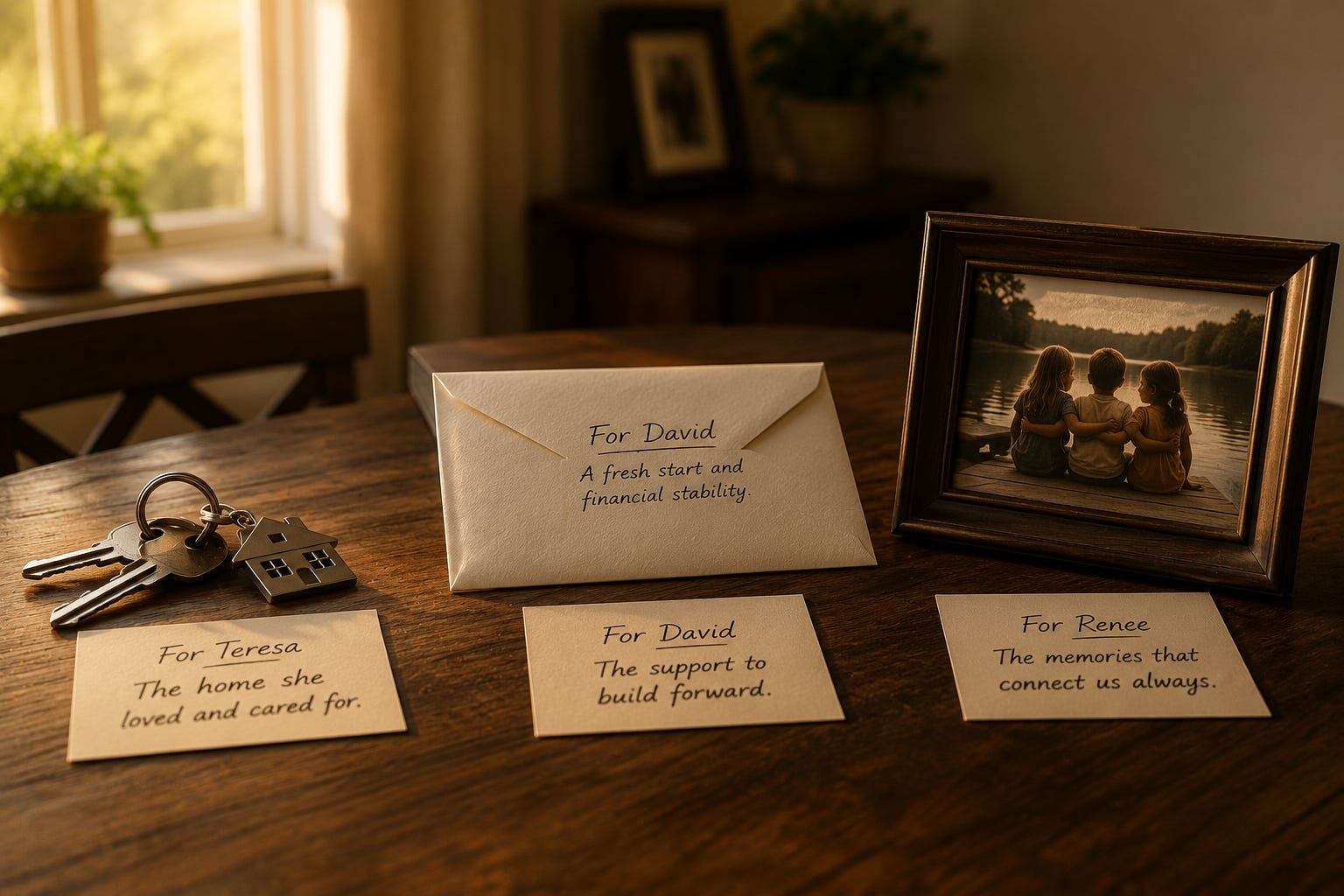
Under both structures, the conversation in life and the trust in operation, Teresa’s experience after her mother’s death looks very different.
The trustee, named in the trust, contacts Teresa within a week of the funeral. He explains the trust’s terms: the house is offered to her at the appraised value, with ninety days to arrange financing. If she cannot arrange the financing, the property is listed and proceeds are split equally. He has the authority to act on those instructions without consulting her siblings, because the trust gave him that authority.
Teresa has the conversation with her bank in week two. She qualifies for the financing because the buyout amount is one-third of the home’s value, not the full value. She closes in week ten. Her siblings receive their distributions in week eleven, one from the trust’s life insurance proceeds and one from the buyout amount. They are not surprised by any of it, because they were in the room when the plan was discussed two years before their mother died.
There is no co-ownership. There are no carrying costs accruing while the heirs negotiate, because there is no negotiation. There are no attorney’s fees beyond the standard trust administration filing. The total time from funeral to final distribution is about three months. The siblings remain on speaking terms.
What “split everything equally” promised was peace among three siblings. What it delivered was three siblings filling in the silence with three different private assumptions about a future none of them had ever been asked to discuss.
The mother’s wish was not the problem. Her silence was. The single sentence she signed could not contain the conversation she did not have, because that is not what documents are for. The document records what the conversation already settled. When the conversation never happened, there was nothing for the document to record except a wish, and a wish does not survive contact with three different lives.
If you have a house, a business, or any asset that cannot be split into equal pieces without being sold first, the structure your will or trust imposes on that asset matters as much as the asset itself. The conversation that informs that structure matters even more. The Estate Planning Blueprint Masterclass is a free one-hour class for families who want to build an estate plan that holds up. It walks through the three things every plan needs to keep probate out, protect children from avoidable conflict, and pass wealth to the next generation cleanly. Readers who recognized the patterns in this post and want to start building the structure that prevents them can register here:
Register for the Masterclass

Readers who would prefer to discuss a specific situation directly can book a free consultation here:
https://lastinglegacypro.com/estate-planning

Their mother wanted three children treated equally. She wanted them at peace with each other after she was gone. She wanted her love for them to translate into something tangible they could each use.
The structures she did not build would have delivered exactly that. Teresa would have kept the house she had been managing for three years. David would have received the cash he needed during his five months of unemployment. Renee would have received her share without the burden of a property she would never live in. Each child would have received equivalent value, in the form that fit their actual life. None of them would have been forced into co-ownership they did not choose, or pressed into roles they did not want.
That is what these structures are for. Not defense. Delivery. They take a parent’s wishes and translate them into something that reaches the children intact, across all the years that follow.
Nathaniel Vale The Legacy Blueprint Estate Planning for Families Who Want to Get It Right