A son is standing in his mother’s closet in Scottsdale at 11 p.m. on a Tuesday. His mother is at HonorHealth, stable but unconscious, two days into what will turn out to be a six-day hospitalization that ends in hospice. He has been told to bring her Healthcare POA and Living Will to the hospital. He knows she has them. He cannot find them.
He starts in the obvious place: the file cabinet in her home office. Tax returns from 2017. A homeowner’s insurance policy from 2014. Six manila folders of recipes, real estate listings, and birthday cards. No Healthcare POA.
He moves to her desk drawer. Stamps. A checkbook. A spiral-bound notebook with three pages of handwritten passwords, half of them crossed out. No Healthcare POA.
He checks the bookshelf in the spare bedroom. The credenza in the living room. The kitchen drawer where she kept “important things.” A plastic file box in the garage. By 1 a.m. he has gone through every storage location in the house and has found a will from 1998 (with his late father listed as executor), a copy of her marriage certificate, three life insurance policies (two for companies he is not sure still exist), and no Healthcare POA.
He has to drive back to HonorHealth at 6 a.m. without the document. The hospital, doing its best, makes treatment decisions based on what they can confirm. His mother spends the next four days on interventions she had told him over coffee, multiple times, she did not want.
The Healthcare POA she had signed in 2019 was in a sealed envelope in her safe deposit box at her bank. He did not know she had a safe deposit box. He did not have access to it. The bank was closed when he needed it.
The eight documents in a complete estate plan only work if the family can find them. The Legacy Binder is the system that makes that happen.
What the Legacy Binder Is
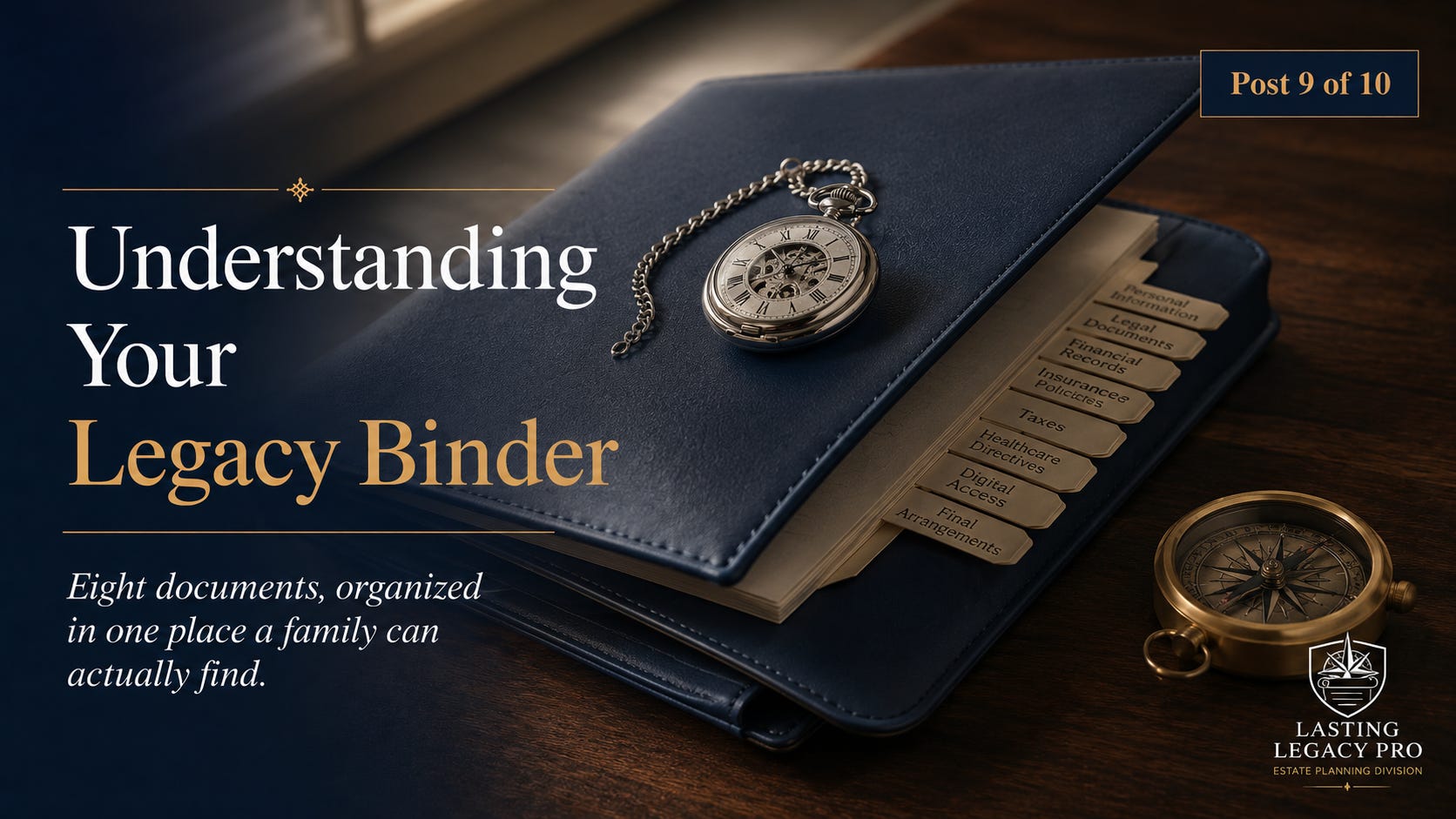
A Legacy Binder is a physical, branded binder containing every document, account record, and family instruction relevant to the estate plan. One book, one location, one place where everything lives.
It includes:
All executed legal documents (Will, Living Will, Healthcare POA, HIPAA, Financial POA, Trust, Beneficiary Deed, Digital Asset Authorization)
An Asset and Account Inventory Sheet
Beneficiary designations across all accounts
Insurance policies and contact info
Final wishes and funeral preferences
Legacy letters (personal messages to family members)
A USB drive with digital copies of everything
Why a Physical Binder Still Matters
In a digital-first world, a physical binder seems old-fashioned. It is not. It is the layer that survives:
A power outage
A hacked or locked digital account
A family member who is not tech-savvy
The 3 a.m. hospital moment when nobody can think clearly
Cloud storage and digital copies are essential backups. They are not a substitute for a single, organized, physical reference a family can pick up and follow.
The Problem the Binder Solves
The most common scenario after someone dies or becomes incapacitated:
The family knows there was a will
They cannot find it
They do not know which lawyer drafted it
They do not know the bank’s account numbers
They do not know which life insurance company has the policy
They do not have the password to anything
They do not have the keys to the safe deposit box
They do not know who the named executor or successor trustee is
Each of these turns into hours or days of detective work. The Legacy Binder ends the detective work. Everything is in one place, labeled, in order.
What Goes in Each Section
A complete Legacy Binder typically has these tabs:
Personal Information. Birth certificate, marriage certificate, Social Security cards, military records.
Legal Documents. Will, Trust, POAs, Healthcare Directive.
Financial Accounts. Banks, investments, retirement, debts.
Real Estate. Deeds, mortgages, property tax records.
Insurance. Life, health, disability, long-term care, home, auto.
Digital Assets. Digital Asset Authorization plus password reference.
Final Wishes. Funeral preferences, organ donation, obituary notes.
Legacy Letters. Personal messages to specific family members.
Professional Contacts. Attorney, CPA, financial advisor, doctor, insurance agent.
USB Backup. Digital copies of everything.
The Asset and Account Inventory Sheet
This is one of the most-used parts of the binder. It is a clear, organized record of everything the grantor owns: every account, every institution, every contact person, in one place.
Without it, the family or trustee may spend weeks tracking down accounts they did not know existed. With it, they can act in days instead of weeks.
The USB Backup
Every Legacy Binder includes a USB drive with PDF copies of all executed documents. It serves three purposes:
Portability. The Healthcare POA agent can carry it while traveling.
Redundancy. A backup if the physical binder is damaged.
Shareability. Easy to share specific documents with a doctor, attorney, or insurance company without copying paperwork.
Keep the USB physically separate from the binder. If both are in the same safe and the safe is destroyed, both are lost.
Where to Store the Binder
Two priorities: secure but accessible.
Good locations:
Fireproof home safe (not too hidden, the family needs to know where it is)
A specific labeled drawer in the home office
A locked filing cabinet a spouse or executor has the key to
Bad locations:
Safe deposit box at a bank (the bank is closed when the emergency happens, and only authorized signers can access it after death)
Hidden somewhere only the grantor knows
Mixed in with general filing
The whole point of the binder is accessibility during a crisis. Hiding it defeats the purpose.
Final Thoughts
The eight documents in an estate plan are the legal infrastructure. The Legacy Binder is what makes them usable. A plan that exists in scattered locations is, functionally, a plan that does not exist. The binder closes that gap. For a few extra dollars in materials, it is the difference between a plan that works and a plan that creates more confusion than it solves.
The son in Scottsdale buried his mother on a Saturday. The funeral was small and quiet. The week after, he and his sister sat down with everything they had been able to recover from the house and started rebuilding what their mother’s estate plan should have been from the beginning. They built a binder. They put it on a labeled shelf in his sister’s home office. They both have keys to the fireproof safe inside. They sent each other photos of the location.
His sister has two daughters, ages seven and ten. She does not want either of them to spend a night in her closet looking for a document she signed in 2019.
A free 20-minute consultation is available throughout this series. If a specific situation needs to be talked through, the link below opens a calendar booking. No pitch, no pressure.
For readers who already know the building blocks they need, the Starter Pack with add-ons can be configured directly.
The next article in the series, Where to Go From Here, arrives tomorrow morning.