

Before we dive in: I’m hosting a free masterclass on exactly this strategy — how to turn retirement accounts, life insurance policies, and overlooked assets into generational blessings that keep working long after you do. If you have something sitting unused and want to know what it could become — this is for you.
→ Register for the Estate Planning Blueprint Masterclass
He had been doing this for forty years.
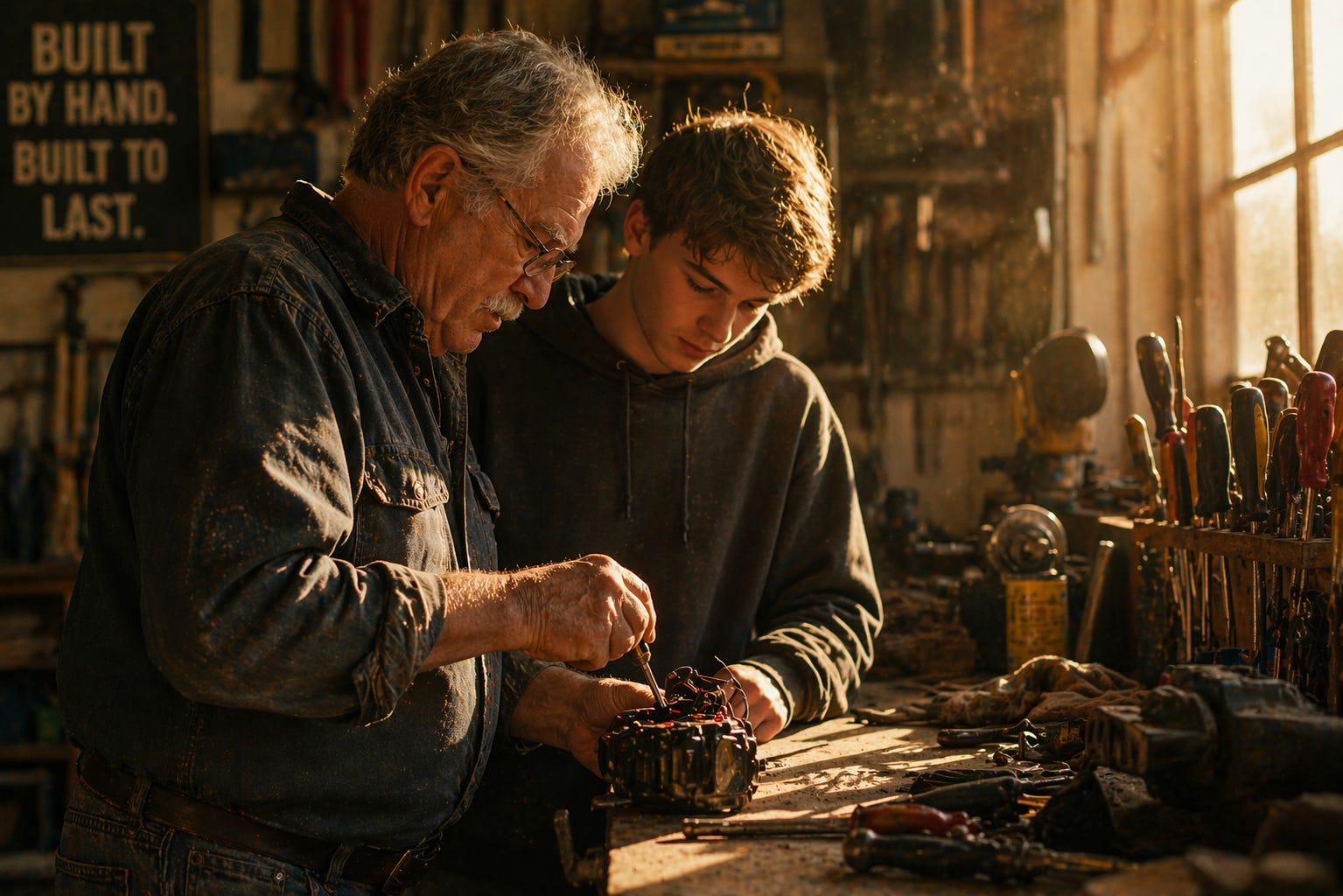
Not dabbling. Not side work. Forty years of licensed electrical work — commercial builds, residential rewires, service calls at two in the morning when the power went out in January. He built a business from nothing, trained three apprentices who went on to run their own shops, and retired with his hands still steady and his reputation intact.
When we sat down to talk through his estate, he was not thinking about money. He was thinking about his grandson, who had just enrolled in a trade program at the local community college.
“I want to give him something useful,” he said. “Not a check he spends. Something that sets him up.”
He paused, then said something I have heard in different forms from dozens of clients across the trades.
“When I started out, I had to borrow my uncle’s tools for the first two years. Showed up to jobs hoping nothing would break. I don’t want him to start that way.”
What he had was a retirement account from a union job he had left fifteen years earlier — $18,000, sitting in a rollover IRA he had never touched. He did not need it. His pension and Social Security covered the life he had built. The $18,000 had become background noise, an account he checked occasionally and never moved.
It was not background noise. It was the beginning of something.
Here is what we built from it.
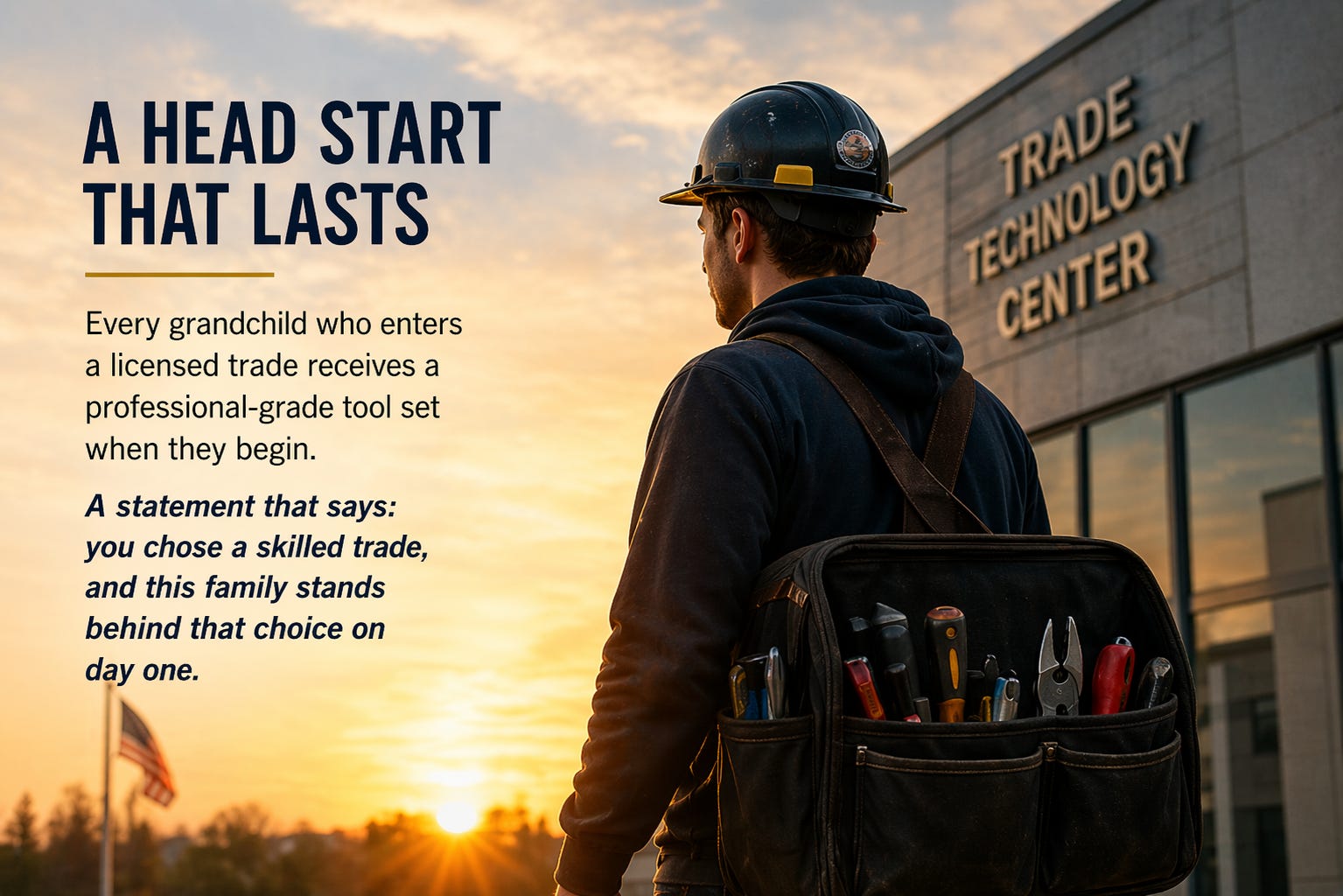
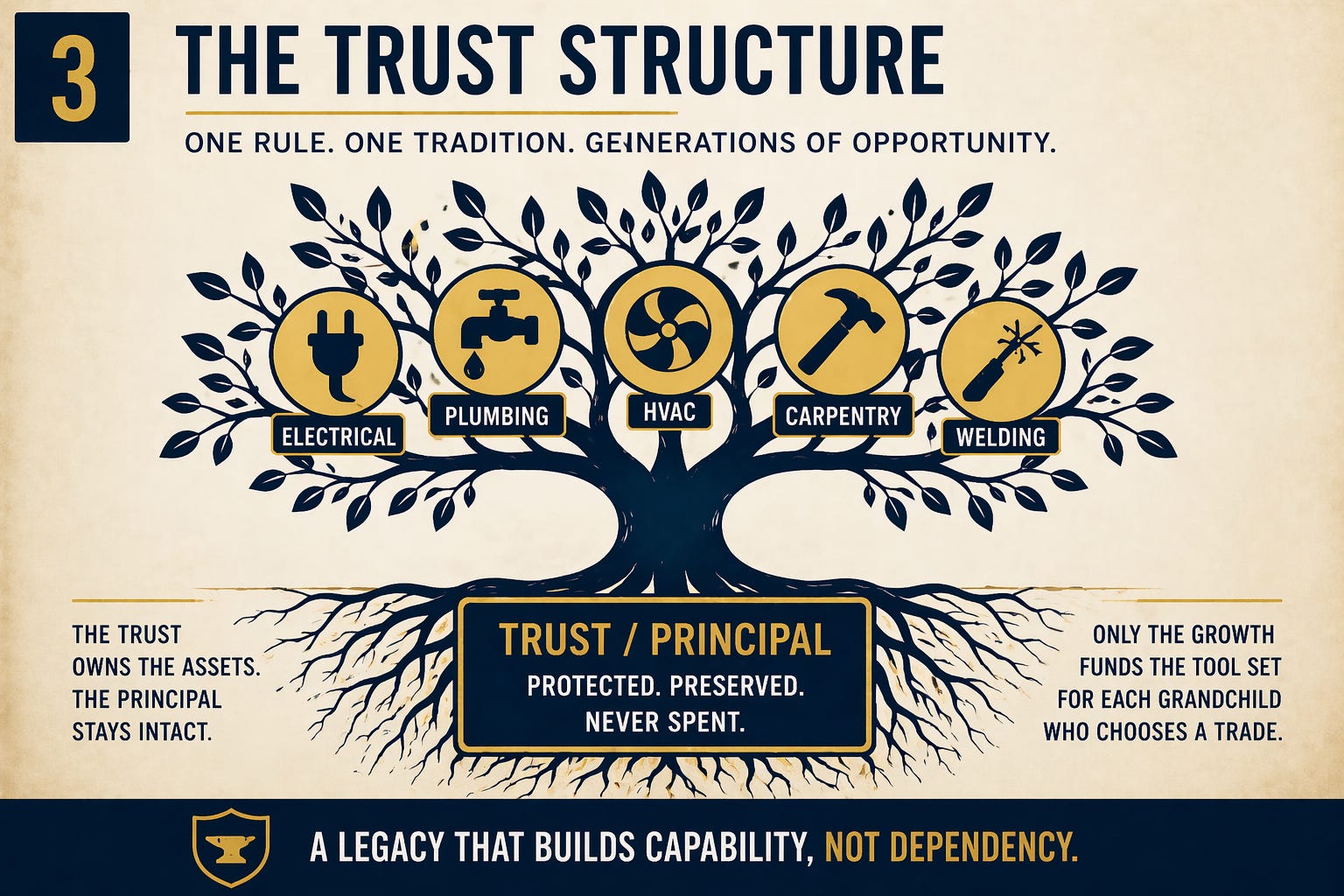
Every grandchild who enters a licensed trade — electrical, plumbing, HVAC, carpentry, welding — receives a complete, professional-grade tool set when they begin their apprenticeship or trade program. Not a starter kit from a big box store. A real set, the kind a working professional actually uses, the kind that lasts a career if it is cared for.
One rule, written into a trust. One tradition, started by a man who spent four decades building things with his hands.
The tool set is not a reward. It is not contingent on grades or performance or proving anything. It is simply what this family does for its own — a statement that says: you chose a skilled trade, and this family stands behind that choice on day one.
The math on this one reaches self-sustaining growth faster than most people expect.
A professional tool set for an electrician, plumber, or carpenter runs between $1,500 and $2,500 depending on the trade and the quality level. That is a smaller annual draw than a first car. Which means the $18,000 seed does not need as long a runway before the growth alone can cover the cost.
The $18,000 rolls into a trust-owned investment account. The trust owns it — not the grandchildren, not the apprentices — which keeps it protected from every well-meaning decision that tends to drain inherited money before it reaches the people it was meant for. The instruction is the same as any endowment: use only the growth. The principal stays.
In year one, $18,000 growing at 7 percent earns roughly $1,260. Not enough for a full set yet. The seed is still establishing itself.
By year seven, the account has grown to around $29,000. The annual growth is just over $2,000. That covers a solid starter trade set in many specialties, with the principal still intact and still compounding.
By year fifteen, the account sits at $50,000. The annual growth exceeds $3,500 — enough to fund a complete professional-grade set for any trade, every single year, without reducing the base by a dollar.
By year twenty-five, the account has grown to $98,000. The annual growth is nearly $6,900. At that point, the trust is not just covering one grandchild’s tool set per year. It is building capacity faster than the family can use it, accumulating growth between draws and compounding the principal toward something larger than the original $18,000 could have suggested.
The money he set aside never gets spent. It gets converted — into capability, into readiness, into the thing he wished someone had done for him at twenty-two.
What happens in a generation with no one entering the trades?
It happens. A family that runs a trades tradition for fifty years will eventually have a generation that goes a different direction — college, business, something else entirely. The trust accounts for this cleanly. The growth that year simply stays in the account, compounding without a draw. The principal grows larger. The next generation that does enter a trade receives a more established fund than the one before it.
The endowment does not punish a generation for its choices. It waits. And while it waits, it grows.
Some families extend the trust to cover any skilled certification — not just traditional trades. A commercial driver’s license. A medical coding certification. A welding certification earned outside a formal apprenticeship. The principle is the same: this family funds the beginning of a skilled career, whatever form that takes in a given generation.
Many families also attach a clause requiring the recipient to complete the first year of their program before the tool set is released. Not as a test — as a timing mechanism. A grandchild who finishes the first year knows whether the trade is right for them. The tools arrive when they are genuinely needed, not speculatively.
This is the kind of planning The Legacy Blueprint covers — practical structures that work for real families, not just large estates. Subscribe free and get every post delivered to your inbox.
The tools are not really about the tools.
What gets passed down through a structure like this is a message that trades work carries dignity and that this family has always known it. In a culture that spent decades steering every ambitious young person toward a four-year degree, a trust that funds skilled trades sends a different signal. It says: we see the work you are choosing. We respect it. We are behind you before you earn your first paycheck.
That message matters more than the tool set.
A young person who enters a trade program knowing their family built something for them — specifically for them, for this choice, before they ever made it — carries a different kind of confidence into that first apprenticeship. They are not starting from borrowed equipment and hoping nothing breaks. They are starting equipped, respected, and expected to succeed.
The practical inheritance travels alongside it. Responsibility for professional-grade tools. The understanding that this equipment represents more than its purchase price. The knowledge that a career in the trades, built on a solid foundation, is a life built on a solid foundation. Many families add the financial literacy clause here too — the grandchild completes a short course on managing self-employment income, tools as a business asset, and retirement planning for trade workers before the set is released. The tools teach the trade. The clause teaches the business of the trade.
He spent forty years building things that lasted. The electrical systems he wired are still running in buildings across the county. The apprentices he trained are running businesses. The reputation he built still precedes him at every shop in the area.
The trust is the next thing he built. It will be running long after he is gone — funding the first day of a career, in a trade not yet chosen, for a grandchild not yet born.
That is not background noise. That is a forty-year career converted into something permanent.
If you have a retirement account, a life insurance policy, or a savings balance you no longer need for yourself — this kind of structure may be exactly what it was waiting for. The Estate Planning Blueprint Masterclass walks through how to set this up, step by step, without complexity and without a large estate to start with.
→ Register for the Estate Planning Blueprint Masterclass
If you are ready to talk through what this looks like for your family:
→ Register for the Estate Planning Blueprint Masterclass
You built something. You spent decades building it. The question now is whether the building stops with you — or whether it keeps going.
— Daniel Lasting Legacy Pro
Thanks for reading The Legacy Blueprint. If this post resonated with you or someone you know in the trades, subscribe free — a new piece like this lands in your inbox every week.